Pages

Search This Blog

Showing posts with label Winter wheat. Show all posts

Sunday, 10 August 2014

Wheat varieties in a bearish market......Choices for 2014/15 season.

With winter barley yields proving to be consistent and high this season, questions about the cost of wheat production this season are rearing themselves daily. With on farm prices off the combine being touted at less than £120/ton, some serious head scratching is taking place in the south west as to what to plant this coming season.

What has been noticeable this season is the wet weather. Right from the outset, October through to May was wet and very mild, record storm surges, high winds, day after day with only a few days respite between storms to get the late planted crops in (after maize, potatoes). The early drilled fields got a flying start and where possible had to have a few sprays of insecticide to keep the aphids off. Seed dressed with Deter had enough protection early on, but this soon faded with the weather onslaught.

With wet mild weather, early ingress of disease was inevitable with Septoria levels in the early new year being high, along with a lot of yellow rust in susceptible varieties. With the ground being so wet and soils relatively warm, plants continued to produce biomass, but not much root as the soils were waterlogged. This continued all the way up till May when the rain abated and temperatures climbed. This was ideal conditions for maize establishment, but some wheats with small root systems started to show signs of strain.

The very mild and wet winter has had another significant effect on winter barley and wheat, namely Take-All. In Lattitude seed treated crops, drilled in early October, there still has been crop damage, that drilled in late September is worse, particularly in fields that weren't rolled post drilling. I have seen Take-All effects in winter barley as bad as in wheat, even barley drilled late October down in Cornwall. In some wheat crops that were drilled as second wheats early (late September) through into the middle of October, it is possible to see which are the early drilled and those that went in last, purely by the degree of Take-All infection in the fields. In other instances, over-yeared seed from 2012 that only had single purpose dressing, was planted in fields following spring barley, purely due to the results of cropping rotation mayhem in 2012, with disastrous results being seen now. I have seen instances of Take-All symptoms in winter barley following winter oats following wheat too, some a complete right-off.

This year, the two cereal demonstration sites were drilled at quite different times, the site at Bude went in early, 25th September, into ideal seedbed conditions. Some varieties have two plots looking at over-yeared seed, a product of the very wet autumn of 2012 when a lot of seed never got planted. Given the issues of 2012, it is hardly surprising that farmers were keen to get the winter crops in early in 2013 to avoid the same issues again. The Tregony site however was opposite, originally planned to go in October, weeks went by with conditions hopeless, until a little window opened the last week of November that allowed the plots to be sown 2nd December. The mild weather definitely helped this lot survive, although some varieties were really up against it and those plots looked appallingly thin. This field was sprayed with Multimax at the earliest opportunity (phosphite and potash foliar feed) to stimulate root and shoot development, which had the desired effect and thickened the plots up well.

Tregony demonstration site mid July.

Bude demonstration site 23rd May with untreated area showing yellow rust in susceptible varieties.

Winter Barley plots at Tregony, Matros in foreground, then Harlequin, Cadillac, California. Matros in rest of field. This field followed winter wheat and suffered some Take-All effects.

In the previous years (2012 and 2013) Avatar winter wheat has been the top yielding variety at both sites, in early and late drilling slots, wet year and dry year. A son of Istabraq and the top perfuming variety in Ireland and Scotland, it has proved itself as a big yielder in this maritime climate of the south west. A variety that was half a percentage point off going on the HGCA recommended list in 2012, it is a very reliable and farmer friendly variety. In trials at Exeter going back to 2008, it has always been in the top 5 in terms of outright performance and across a wide range of sites in the HGCA trials system it performed well. It was the variety that caught my eye back in 2009 at Exeter, I started including it in farm trials in 2010 and it has proven a very consistent and forgiving variety. planted early, it doesn't get too proud and full of disease like Istabraq can (thats why its always advised to plant Istabraq late down here, possibly the best wheat variety after maize), planted late (end of February, it has amazing tillering capacity and a fantastic yield potential. I have a case of it being planted the 19th of March this year and it has flowered and produced a great crop. That is nearly as forgiving as Claire! Due to it's high tillering capacity, it lends itself to the Claydon system of minimum tillage, as can be seen below.
Avatar drilled in November with a Claydon drill, near Crediton.

Avatar in a field thats been continuous wheat for 30 years, looking fabulous. Drilled at 230 seeds/sqm in late mid September 2013.


Avatar produces a good bright sample with a high specific weight.

Since starting this we have now harvested about 400acs of wheats, predominantly Istabraq and Avatar. Yields for Istabraq are in the 3.75t/ac range with a good specific weight, with Avatar in second wheat/continuos wheat slots doing the same and between 3.8 and 4.25t/ac in the 1st wheat slots, again with very good specific weights. There are are a few results that I am waiting on from the Crediton and Truro areas, but at the minute yields are promising for a difficult year.

I am hoping we will have the trial plots harvested in the near future which will then give us an indication of where the new varieties like Zulu, Panacea, Evolution and Revelation sit in the mix. Revelation does look promising at the minute, Panacea may surprise with its yield too.

More to follow soon.


Tuesday, 20 November 2012

Weather issues!

Well most of us have and are having to deal with weather issues, most likely for the next 18 months as the after effects of this years weather ease their way through the next cropping year. What do I mean by this, well it matters little what crop you are growing, whether grass or arable, compaction and subsoil damage from stock and machinery will have been considerable this year and these are very noticeable in autumn sown crops already this year and will be evident in grass growth rates in the spring.

About 40% of autumn crops are in the ground down here in the Southwest, a large amount of grass reseeding never got done because the ground conditions were poor too and any Oilseed Rape that was drilled has sustained a prolonged spell of attack from slugs and what is left is now being piled into by pigeons en masse!

To top it all, spring cereal options are now difficult with the chronic lack of spring cereal seed available.  I am not panicking yet as I think there will be seed coming available after new year that has been ordered on the proviso the wheat that was planned is not drilled. I know a lot will say that because the ground is now so wet, there is no chance in hell of it being dry enough to drill by the beginning of February. I remember clearly the statements earlier in 2012 about it taking years to recover the subsurface moisture deficits in much of England due the extreme drought conditions, look where we are now 7 months down the track. If we get this very cold weather that some forecasters are predicting, winter ploughing and late drilling winter wheat is still an option, especially any varieties with Claire in their parentage. Last year we were drilling Istabraq on ground at 800ft on the 1st of March and it still yielded more than all the earlier drilled stuff.

So don't panic, there is time yet still to get winter wheat in the ground, we still have a lot of weather to go through before spring and hopefully that which is planted will have a deep enough root system to survive while the cold weather kills off the slug problem and does something to remedy the soil structure issues. Just remember to raise the drilling rates up towards the 450 seeds/sqm level to account for higher seed mortality and reduced tiller numbers and don't drill too deep!

Saturday, 8 September 2012

Playing Russian Roulette

For a fortunate few, Harvest 2012 is drawing to a protracted and very difficult close, certainly this is a year that we aren't going to forget in a hurry!

It has been a revelation this year, a 'shake out' year as one of our breeders described it, as some serious issues that potentially threaten wheat breeding program's are starting to emerge with some very serious consequences for UK farming.

In the past some breeding program's have focused on genetic resistance to regular disease pressures, septoria tritici being the main one, with other traits being bolted on. Some other breeders have been focusing on all out yield, regardless of how genetically strong these varieties were, their consensus being that disease risk could be managed by chemistry tailored to curb disease outbreaks. Barn filling varieties with poor to average disease traits proliferated as farmers bought into the idea that chemistry could solve all disease problems. As with anything in nature, disease pressures and mutations give rise to new challenges. Single gene resistance to disease instead of dual, or multiple gene resistance is easier to breed into new varieties and allows quick turn around from lab to field. As a consequence we are now seeing multiple incidences of varieties succumbing  to Yellow Rust and Brown Rust strains that are evolving, varieties that have only just been registered on the HGCA recommended lists, with the resultant increase in usage of full blown ag-chem programs to try and control these issues.

Throw into this mix one of the wettest growing seasons, especially from pre flowering all the way to harvest with low solar energy levels, high humidity and very damp soil conditions and you have a perfect storm scenario for a whole host of new diseases to make their presence felt too, especially Fusarium which has quite literally sucked all yield out of wheats this year, apart from those like Istabraq that has not suffered as much and is still producing a reasonable sample.

A common theme I am hearing on farm is a new level of questioning with regard to ag-chem inputs, how expensive this last season has been to get a crop that basically isn't near covering costs. It's is interesting to note how some of these chemistry suppliers have gone from small scale operations to giants in the industry in a very short period of time, considering how long the 'green revolution' in agriculture has been going on for. In a very short time span, farmers have seen their supply base of agricultural chemicals diminish considerably down to just a handful of players in the market, with the agronomy angle reduced even further and geared almost exclusively to structured spray programs. In a wet year like this last one, total reliance on sprays to control disease has been severely tested and the basic fundamentals of genetic resistance and a variety's ability to cope under stress have been fully on display. Some have coped and a lot have not.

Soil science, I would say is one of the most important factors governing yield, has been largely forgotten, farmers have devolved responsibility in many areas to their ag-chem supplier and crop walkers who supposedly are more knowledgeable in maximising yields and thus returns on their behalf. The knowledge gap on farm has been further diminished as a result of squeezed margins in the 'naughties' that lead to farmers farming more acres with less personnel and thus being more time restricted to chase knowledge in this regard. Universities and Agricultural Colleges too reduced the soil science input and concentrated more on the chemistry and machinery aspects of tillage, horsepower and technology as soil science generally was considered boring by most students. How many modern day farmers really understand and know what is going on in their soils?

A common theme I hear on farm is this; "why is it that with all your new fancy varieties you are breeding I am still only getting the yields we were getting 10 years ago"? Well, this time I heard an answer that came from a soil specialist company that has been growing a database on soils across the UK for the last 10 plus years and what he said was scary. The basis of it is this, pure arable farmers have been depleting the soil organic matter for so long with simple cereal and rape rotations that in some areas these levels are so low as to be irreplaceable, the soils have had all the life sucked out of them and as a result they physically are unable to provide the growing crops with the nutrients to attain their genetic potential.

It really has been noticeable in fields this year, those with good organic matter, good structure, good nutrient status have still delivered a reasonable yield and machinery has still been able to travel at critical times without leaving 3ft deep ruts. A farmer I know in Wiltshire has been chopping his straw for 10 years now, been applying copious amounts of compost and maintaining his lime and nutrient status with almost religious zeal. On very heavy clay over chalk, he has managed to keep going during harvest when his neighbours were getting stuck, his fields have a natural 'sponginess' to them as you walk them with very few areas of standing water in any of them, whilst neighbours have had 6" across whole fields of standing water for long periods of time. When you look where the combine has been traveling, there are no deep ruts, look over the hedge and it looks like a battlefield.

The genetic potential of some of the older wheat varieties like Einstein is well in excess of 25t/ha, we know from data attained in New Zealand these varieties are currently doing 18t/ha on farm in places consistently where the fertility of the soils has been maintained and the soils well managed in terms of rotation, organic manure levels, trace element replacement and most importantly, soil structure. These farmers have good rotations with break crops designed to replace organic matter and recharge the soil nutrient levels, instead of relying on stuff out of a bag. UK farmers in the main have not been doing this and yield increases have largely flatlined.

We need a radicle rethink in how we manage crop rotations, increase soil organic matter levels, improve soil structure and rejuvinate trace element levels. We need to sometimes stop and think; the soils we are farming are the product of millions of years in the making, yet with our modern cropping methods we are depleting their ability to produce the very food that our growing populations will need in the future.

How are the future generations of young farmers going to produce a decent crop that provides an economic return if the very medium needed to grow it is barren? Those who think GM will gallantly ride to the rescue are sadly going to be disappointed because the focus in GM at present is geared towards mainly chemistry, rather than soils.

The last 5 years have in the main been benign to cereal varieties, yes there has been pressure from disease, but the weaker ones were still able to deliver a credible yield with a lot of ag-chem help. This year we hit chamber six and it has blown a huge hole in many a bottom line  Lets hope this year the HGCA clamps down on low disease threshold varieties whose presence on the list now is very questionable and we move away from 'spray and weigh' varieties.

Friday, 18 March 2011

Cornish Wheat Demonstration Plots 2011.

 
Xi 19: Cadenza x Rialto cross.
 Group 1 with potentially high yields even in the west country. Suited to later planting slot as vigourous grower. Good straw length, strength. Has a distinctive ear, moderately resistant to sprouting, can be sown late into February. Moderate disease profile as with some older varieties, been on the list for a long time before dropping off in 2011.


Except : Torch x Hereward
An old group 2 with exceptional septoria resistance, very stiff and short strawed with a very bold high specific weight grain. Suitable for organic production as well. Being outclassed now in terms of yield, an early drilling variety due to its slow growth habit in autumn. Seed stocks getting low which will hasten its unfortunate demise.

Einstein: Haven x Clarion cross.
World record holder for highest yield/ha. A group 2 with no major weaknesses, a good second wheat variety with good bold grain and specific weight, consistent across whole spectrum of soils and environments. Pretty much bomb proof.


 Panorama: Solstice x Xi19
A variety born out of great parentage, tall stiff strawed variety that holds great promise in this region, does very well as a 2nd wheat and on heavy land. A consistent high yielder with good specific weight, good disease resistance and resistance to sprouting. Did exceptionally well in 2010 when it was very dry, as being tall strawed, it had very good root development below ground and didn't suffer drought stress like other short varieties did at the Nickerson test site near Exeter.


                                                              Claire: Wasp x Flame
In it's 13th year on the recommended list, no other group 3 variety has been as consistent. Well liked for it's good disease profile, straw, standing power and multiple use applications from feed to milling, distilling and export. Likes the early drilling slot due to it's slow growth habit in the autumn, but can also being sown late up till end of February.


 Invicta: NSLWW48 x Robigus
New variety added to the RL in 2010, tall strawed, relatively stiff, Group 3 with a good disease profile. Has yielded 2% above Robigus. Will be interesting to see how it fairs here.


  Alchemy: Claire x (Consort x Woodstock)
Another variety of good parentage. Consistent, excellent disease resistance characteristics, produces good long stiff straw, with good specific weight. Suited for export, or feed, a slow grower in the autumn, but can be drilled late up till beginning of February.


Edmunds: Deben x Napier
A high yielding variety that didn't make the RL, similar yield and disease profile to Viscount, does very well on the east coast, outyields Alchemy by 3% , similar to Viscount. Short stiff strawed variety with good specific weight and grain suited to the animal feed market.


Istabraq: Consort x Claire
Long strawed, consistent high yielding variety that has dropped off the RL now this year. Produces big bold grains, with a god disease and particularly good Fusarium resistance making it ideal for the late sown after maize slot. Likes light land, has very good root stucture so can withstand drought stress well. 


 Cassius: Claire x (NSLWW24 x Wizard)
A very high yielding variety well suited to the north and east, short strawed, with very good yellow brown rust and mildew resistance. Does well as a 2nd wheat. Will be interesting to see how it does here.


 Gravitas: Alchemy x Robigus
Alchemy Mk2; 5% higher yielding than Alchemy, with a very similar robust disease profile, straw and growth habit, similar specific weight, as well as Orange Blossom Midge resistance. This variety should do really well in this area, so it will be interesting to see how it compares to the others.


Sahara: Savanah x Claire
This variety is being superceded by newer types, but it still has a very useful place on fams in the west. It has an excellent disease resistance profile, high specific weight, similar yield to Alchemy and does well as a 2nd wheat. Has a long stiff straw too.


 Stigg: (Biscay x LW96-2930) xTanker
A new and very interesting variety. There is no other variety on the RL that has a better disease profile! With an 8 for Septoria resiatance, 9's for rusts, 7 for eyespot and mildew, 6 for Fusarium, there is nothing else like it. Shortish,  stiff strawed and a distinctive ear, it is going to be interesting to see how this variety does. Has the highest untreated yield of any variety, so lends itself to organic production and low fungicide input regimes. Dairy Farmers wheat- put it in the ground and shut the gate till harvest type of plant. Only chink in armour is its slightly low specific weight, but from an animal feed / home roled and feed/ wholecrop point of view, not really an issue. Matched Alchemy last year in a low input scenario, so will see how it does here, at Sticklepath near Dartmoor (750ft) and Pelynt in South Cornwall.


 JB Diego: 3351b x Stru2374 (?)
High yielding hard feed wheat variety with tall stiff straw and mixed disease profile. Does well as a 2nd wheat and has good specific weight. Bred in Germany.


 Robigus: Z836 x 1366
Good 1st wheat, not 2nd! Mixed disease profile, now highly susceptable to Yellow Rust, moderate for sprouting resistance and being outclassed in yield terms too. Still has good Septoria resistance and still grown by quite a few farmers in Devon and Cornwall. Will be interesting to see how it fares this year.

 Deben:  (Hunter x Buster) x Wasp
An older variety, but useful nonetheless. Long strawed, a good disease profile, with good yield potential, also does well as a 2nd or continuos wheat. Does well on lighter, less fertile soils. This is the control variety with the rest of the field being drilled to Nickerson Original seed, so we should get a good yield comparison for all the varieties.


 Oakley: (Aardvark sib x Robigus) x Access.
Still the highest yielding variety on the RL, but downgraded due to poor yellow rust resistance. Agronomists favourite as you can sling as much chemical as you like at it and generally will give a yield response. Short strawed moderately stiff, moderately resistant to sprouting, preferably as a 1st wheat.


 Duxford: Solstice x Scorpion
A high yielding hard group 4 variety that does well as a 2nd wheat. Best suited to mid to late drilling slot, has a mediocre disease profile and is already showing signs of Septoria infection. Going to be interesting to see how it fares down here over the season.

Will keep an update of the plots and post accordingly, we will be having an open day where farmers from Devon and Cornwall will be very welcome to come and see for themselves how the varieties perform and question me and collegues on variety choices for 2011/12.


Tuesday, 8 March 2011

The cruel reality of a hard winter.


Bottom end of the same field.
Winter barley looking very sad, reality is that when you do the plant counts, the numbers just aren't there.
The best of the winter barley in this same field....
Click on the picture to see in full size, clearly shows exposed roots.
Another field of winter barley looking beyond recovery.
Einstein winter wheat, drilled in the normal timeslot, but this area of the field lies wet, normal year would have been OK.
If there were small roots, one could be forgiven for thinking too late drilled. However, there's plenty of roots here, most plants have really good root development, just not enough when you have this much frost heave in these heavy wet soils.
Contast this picture of late drilled Istabraq winter wheat with the Einstein above. This was drilled after maize in late October, but because it is slightly drier ground, not problems with frost lift.


And this is how you would expect the crop to be looking at this time of year. Panorama, fantastic group 2 winter wheat, wildly underated just like Istabraq. This was planted 1st week October 2010, drier ground near Bude.  Just shows the difference of 10 miles as regards factors affecting crop performance.

Tuesday, 4 January 2011

Frost damage/heave in Winter Wheat.

With the price of wheat futures rising well over £200/ton and the November price at over £170, things in he arable world are looking quite promising for this season. However, the recent very cold weather has played havoc with some wheat plantings here in North Devon, especially the poorer, wetter lands. With temperatures plunging down to -18C in places near Okehampton in the week before Christmas (I saw -13C at Exeter airport on Christmas eve), things got pretty chilly down here for a while, especially as the daytime temperatures struggled to get above -5C.

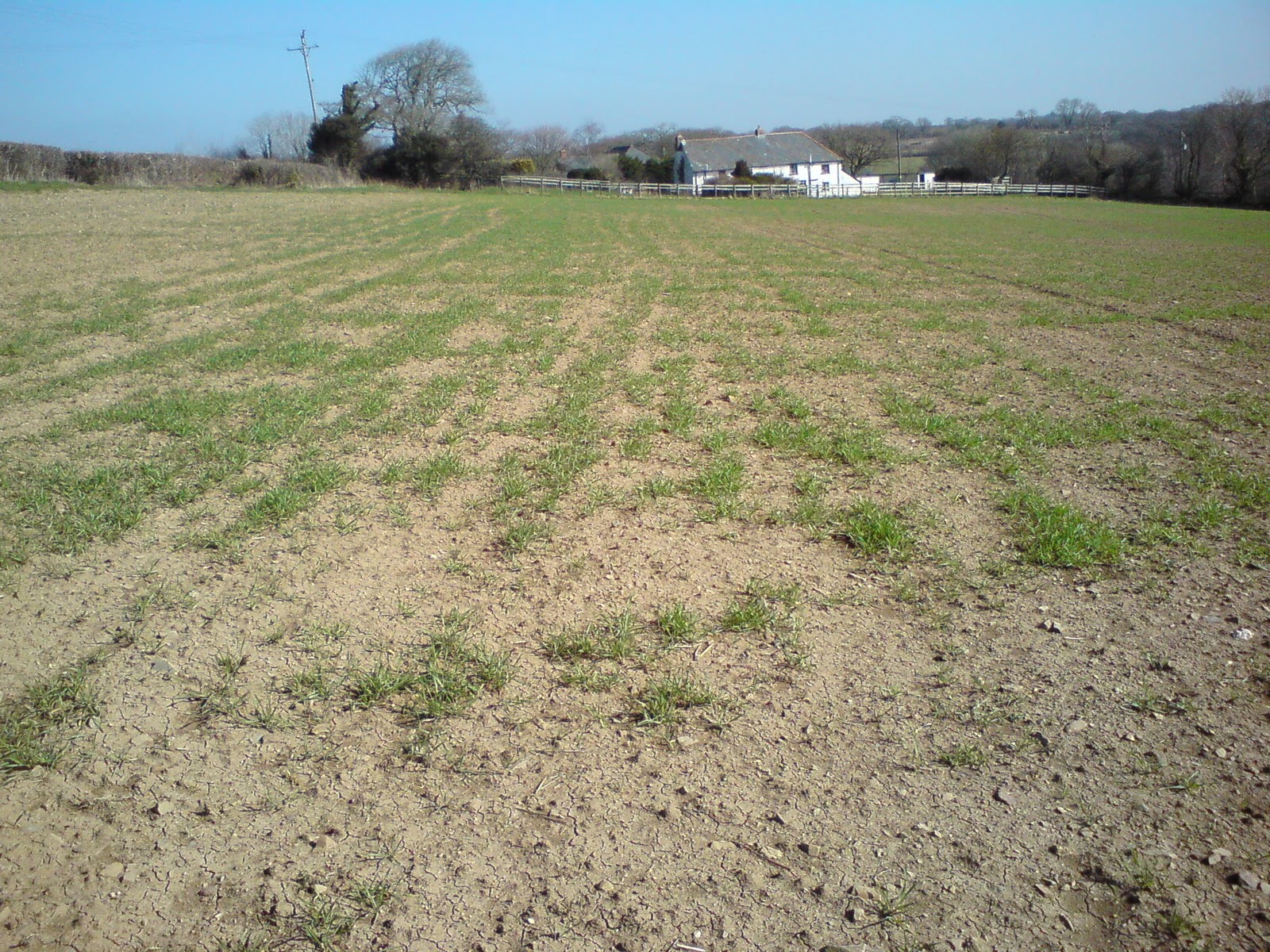
This prolonged cold spell for the whole month of December, followed by a very rapid thaw just before New Year has left us with some scenes like this below. There is hope yet that the damage can be salvaged later when Growth regulator is applied with a additional foliar feed of Multimax to boost additional root development and allow some plants to survive. A very cold dry spring won't help though if we have similar weather to last spring.


Fortunately I haven't come across any of my customers with total, or near complete loss of autumn seeds. Nickerson Original seed does come with a filmcoat package that both protects the seed from phytotoxic effects of seed dressings, as well as stimulates root and root hair development in the first 6 weeks of growth, something which is key in getting good autumn establishment. Yes it costs a couple of pounds an acre more, but with a winter like this last one, it certainly is going to pay off.


My seed in the foreground, the 2 fields on the bank directly behind aren't and have 50-90% losses. This below is a neighbours field of grass seeds...... Not Circle Leys, which would have come through OK given they have the same film coat.

Saturday, 4 December 2010

Cornish and North Devon wheat variety demonstration plots.

For the first time in many years, quite possible for the first time in Cornwall, I have put in two wheat variety demonstration plots to show farmers what these different varieties will do 'in their back yard' so to speak.

Nickersons has had a trial site just north of Exeter for many years, near Silverton, where a whole range of varieties from the recommended list(RL) are trialed to measure performance in the 'west'. This is all part of the recommended list certification process and the main site for septoria screening. It is also where all the new pre RL material is tested too, somewhere in the region of 300 new upcoming variety lines.The site features treated and non-treated trials to see what plants in-bred genetic resistance levels are to a range common fungal deseases.

There is normally an open day that is run by Masstock, with whom we share the site under the 'we do the land prep, plant it and harvest it, you spray it' arrangement. The site is on free draining,  fertile red soils that aren't really representative of the heavy clays and shales found in Cornwall and Devon south and west of Exeter, nor does it have the disease pressure from 60 inches of rain found elsewhere. After hearing the feedback from numerous farmers in Cornwall and North Devon about these non comparative issues, I have found two farmers who were prepared to undertake these demonstration plots.

The North Devon site is near Holsworthy, heavy wet clays, not the best ground in the parish, but representative of soils farmers are trying to grow wheat in and here is a short video of what they look like at the end of November.


The Cornish trial site is near Tregony, on the Roseland peninsular, not far from St Austell. There is a lot of wheat grown in Cornwall, mainly for stock feed, so this site is ideal to show local growers the strengths and weaknesses of these varieties. Both sites will have an untreated strip through them too so we can see what Septoria resistance there is, as well as demonstrating to those organic growers what they too can expect. This site has 5 more varieties than the other too which is an added bonus. There will be open days at both sites in the new year and a proper open day event as well at both just after the Cereals Event. Dates will be announced.

Tuesday, 28 September 2010

North Devon Wheat Demo

For the first time in many years, we have a 14 varieties in the ground as of today at Holsworthy!

I think it is important in this day and age that we trial varieties outside of mainstream areas, really push and pull them from a disease pressure point of view, challenge them in heavy wet ground in a high rainfall environment. North Devon is not renowned as being part of the great grain belt of the UK, however it is an important livestock area and these animals need feeding. There is a lot of wheat grown in this area and there are many traditional methods being employed to grow it, along with very robust spraying programs that are becoming ever more costly. So the challenge is to try doing it slightly differently, utilise more organic forms of nutrition, utilise biogass as much as possible for Nitrogen requirements and see what varieties fare the best in this environment under a treated and untreated regime.

Thanks to David Prouse of Roy Prouse Contractors for allowing me to use one of his fields to do this demo and thanks to Steve Cleave who did the driving and drilling. Hopefully all will be revealed in not too distant future and we will have an open day to show farmers what we have achieved.

Wednesday, 1 September 2010

Harvest Update

The curse of that saint who got 40 days rain......well it's happened again...! Fortunately not to the same extent as last year, or as bad as 2008, but rain has definitely taken the shine off some farm harvests this year.
Winter Barley harvests have been respectable, with some outstanding specific weights achieved with Pearl, one grower getting figures of 3.25t/ac with a sw of 74!!
One common thread of information coming back with the rain interupting the barley harvest has been Suzuka brackling and dropping ears before the combine could get to it.
Wheat yields on the heavier soils have been reasonable, even on areas that were affected by the prolonged dry spell, with sw's in the high 70's. A number of farmers are claiming yields over 5t/ac on some varieties, one grower I know claiming Lear outyielded everything by 1t/ac and he's not one to make such claims lightly.
However, after last weeks heavy rains, there is a lot of sprouting wheat being now cut which is taking some of the shine off proceedings.
Here are a few photo's taken today of combining at Ashwater. Lets hope the weather holds out till it's all in!!

Thursday, 15 July 2010

Frost heave/lift on winter corn.


Above is Nickerson Original Alchemy in very heavy claggy clays at Whitstone, near Launceston which came through the winter without much suffereing, even though there was standing water that froze here. Below is Original Istabraq at Ashwater, again no issues with the very hard frost and wet this last winter.


Contrast this above with this below of other seed, with the effects seen though in later growth stages.


Seen a lot of this this year after the very cold winter, following a very wet Autumn where late drilled wheat suffered badly.

Monday, 10 August 2009

Small miracles


Same fields of Timber showing signs of recovery, taken 29th April and 15th May.