Speak to many westcountry farmers and the opinion is the same, we have never seen a 'summer' like this one, in fact the whole year has been pretty much up the spout with no let up in difficult conditions.
With harvest struggling on and the results looking far from brilliant so far, it is great to hear a success story, well success in part anyway. A while ago I put a short clip up on youtube where our Sales Director Alastair Moore and I were looking at the ins and outs of establishing Oilseed rape, the link to the clip is down below. Our Rape breeder has been saying for years that canopy management, establishment and nitrogen influence final yields much more so than the individual variety that are ranked on the HGCA 'descriptive' list (I call it descriptive, because some of the LSD numbers are so far out so as to make the results statistically null and void). We get shoehorned into chosing varieties according to their results on this list, which incidently through the way the data is gathered is automatically selecting for taller and later maturing varieties, not ideal given the conditions this year!
Last summer a variety called Artoga, bred by Limagrain, started to raise it's profile because it was doing stunningly well in large parts of Europe and was one of only a few varieties that proved it could survive bitterly cold conditions and produce a crop that doesn't readily shatter at harvest time. I persuaded a few of my customers to try it and lo and behold it does what it says on the can! One of my customers on really wet heavy and very marginal soils on the cornish border put some in with a Sumo, very late (late September) and although we had a mild autumn, the fact we had so much rain drowned quite a bit of it where water pooled and sat from November through till March. However, on the one field that is south facing and reasonably well drained it was stonkingly good. Considering as well that it didn't have an autumn herbicide, that it only had one fungicide spray during it whole lifetime, to end up with an average yield well over 1ton/ac is encouraging, given that some crops that have had everything thrown at them are only doing 1.5t/ac. To appreciate how much abuse it had, it was dessicated and then left a good 3 weeks enduring torrential rain and thunderstorms, with long spells and damp mizzle thrown in as well, followed by bursts of very steamy hot weather before the combine managed to get to it last weekend (11th August). The grower fearing the worst gingerly started cutting thinking that most of the seed would have dropped out, or worse would start shedding from the vibration of the cutter bar on the combine. I am happy to report his worries were unfounded; no lodging, no cutterbar losses, no shedding!
Elsewhere we are seeing yields consinstently in the 1.55-1.8t/ac range down here, which given the conditions and the season is quite encouraging and certainly on a par or exceeding the yields of the high ranking varieties on the HGCA list.
http://www.youtube.com/watch?v=VsNHjSykIwM&list=UUCuUvslFtDuEj6bQPEOHIxA&index=4&feature=plcp
Showing posts with label Nickerson Direct. Show all posts
Showing posts with label Nickerson Direct. Show all posts
Friday, 17 August 2012


Sunday, 8 January 2012
Farmers Guardian article December 2011
Taking a 'holistic' approach to dairy management is allowing better returns to be made.
Growing a specialist variety of grain maize , as well as lucerne and grass and managing it according to specific advice from leading forage experts Nickerson Direct has resulted in North Cornwall farmers Michael and Anthony Grills being able to consolidate and expand their dairy enterprise even in the face of price adversity.
Continuing pressure on the dairy industry has encouraged Michael and Anthony to focus on increasing efficiency and cost-effectiveness over the last few years, during which they have expanded their dairy business from 250 to 320 cows, with the eventual aim of reaching 500. They have also implemented major advances in genetics and nutrition, reduced costs, improved attention to detail and increased profitability.
Until 2009, cropping at West Trelay Farm, Marhamchurch included 60-80 acres of forage maize, which was included in the ration at the rate of one part to two parts grass silage. However, the Grills found it difficult to achieve consistently good results from forage maize and variability in the clamp made correct rationing difficult. Typical butterfat levels struggled to get to 4% on the wheat and barley mix as a starch source along with forage maize, which when on a cheese contract is costly.
In early 2009, Nickerson Direct Seed Specialist Simon Montgomery suggested that Michael and Anthony include grain maize with the forage maize as an additional energy source to supplement grass silage, its higher energy/starch content significantly improving milking performance and making the ration easier to manage throughout the year.
The initial crop produced an average of 5 tonnes per acre of grain which was put into the clamp for £68/t, making it very cost-effective. The maize fed tremendously well, with average butterfat content increasing from 3.98% to a maximum of 4.54% during the winter and never dropping below 4.2% the following summer, while protein remained at 3.18-3.21% throughout. The resulting increase in the quality of the milk, all of it contracted to Dairy Crest for cheese production, netted the Grills a 1p/litre quality premium worth £25,000 per year.
It was so successful that in 2010 they substituted the area of forage maize for grain maize, drilling 90 acres of Lorado between 18th and 21st April. The crop established quickly in favourable conditions, grew consistently throughout the season despite being subjected to severe drought stress and in terms of maturity behaved more like a Group 9 than its official NIAB Group 7 rating would suggest with harvest completed by 17th October and averaging a respectable 4.5 -5 t/ac in yield.
This year, the area was increased further, with a number of fields being 3rd year grain maize. 2011 started off far drier than 2010, with the crop being planted on the 14th and 15th April in ideal conditions. What was startling though on the light ground was how much moisture had been retained by the 2 previous years mulched stalks, allowing easy seed bed preparation and perfect planting conditions giving a very even plant establishment, something others struggled with this year. Herbicide applications also worked well. Even with the extremes of weather this year, first hot and dry, then cold and dry, followed by cool windy and wet conditions from 15th June onwards, the crop looked good.
By the 11th October the crop was ready to harvest, even after the poor growing conditions this year, with contractor Phil Strout combining 4 - 5 tonnes per acre (at 30-34% moisture) of what Anthony Grills describes as ‘a wonderful product, like gold dust’, although he acknowledges that their location on relatively dry ground in North Cornwall favours the crop. The fact that Lorado dries down quickly, right to the base of the kernel, 'enables us to put it through the crimper efficiently, producing a gritty flour type product, even though we are adding water with the acid type preservative, which as a result has increased surface area allowing easy digestion in the cows' gut. We're also getting better protein values from the maize as a result of using this method. In doing so we are reducing the overall acid loading on the cows digestive system, which with good quality grass silage is making a noticeable difference'.
After appraising and careful consideration with Simon, a trial field of Lucerne was planted in one of the drier fields 'to see what happens'. Simon's past experience of growing Lucerne in Zimbabwe helped in getting a fantastic establishment in difficult dry conditions. The first cut was made mid July, being left to wilt for 4 days with one turning with an old Vicon Acrobat doing the job very well without losing the leaf, before row up and baling. The Lucerne was chopped as being baled, resulting in very dense, tightly packed bales which had an additional layer of plastic to stop any 'porcupine effect'. The resultant forage has surpassed expectations. The second cut in early September was done the same way and has analysed equally well, yielding similarly at 8 600kg bales per acre. Next year, four cuts should be easily achievable.
 Sowing Lucerne near Bude, 15th April 2011
 Establishment is everything with lucerne.
 Cutting and wilting properly, without loosing the leaves is critical
The inclusion of 1.5 kg per cow of Lucerne in the diet has raised protein levels from 3.18 to 3.35%. It has also allowed the removal 0.25kg per cow of soya from the ration, saving over £900/month in bought in soya cost. It has also helped boost butterfat levels which are now up to 4.64% in cows producing 10,000 litres of milk. The milk from forage figure is now standing at 4500 litres, from grazed grass and grass silage only, as the grain maize is treated as a concentrate.
What is noticeable too is how cow health is improving. Cows are very 'on the go'; alert, but contented and relaxed looking when you study them, they do not look tired and lethargic. They are showing better bulling signs and better holding post AI. As a result the cull cow numbers have reduced, calving index is improving, there is now a surplus of heifers being reared which is providing another good revenue stream to the business.
Soil management has also been appraised, some time ago soil conditioning fertilisers became part of the crop fertilising regime, recently the inclusion of 'bugs' into the slurry towers is enhancing nitrogen values by 18-20% with silage ground staying green after cutting, rather than the usual browning off period whilst swards recover. This has lead to a reduction in bought in Nitrogen fertiliser use over the whole farm, particularly in the grain maize fields, the flora and fauna levels in the soils as a result is improving along with soil structure.
The combination of crimped maize and Lucerne in the diet has added an additional 1.5p quality premium to their milk price, which is making the business far more viable. It is also providing the basis for a more balanced diet, with good quality grass silage under pinning it. 'Most importantly, the growing of grain maize at £70 per ton in the clamp, the improved milk price as a result of better quality milk, the savings from inclusion of Lucerne into the diet has stabilised the farm business, on the borrowings side and the new bank protocols, our business is more sound and is allowing us to push forward and further invest in our enterprise.
As Simon has said before, "Dry grain production requires varieties with rapid dry-down rates, harvested after the leaves have died back and typically followed by the removal of 10%-15% moisture in a dryer, which increases the cost of the final product and is a major factor in steering producers towards moist storage after crimping".
“The high energy content and slow starch degradation characteristics make crimped grain maize an ideal moist concentrate feed for high-performance dairy and beef animals. It is convenient and reliable, ideal for use on farms where maize silage area is limited but where additional starch is required in the diet. Typically, the nutrient analysis for crimped grain is 65%-75% Dry Matter, 12-13 ME, 9-11% crude protein and 60%-70% starch. What makes Lorado so good is that it typically has a protein value of 12.7%, much more than other varieties and this does make a big difference in the ration".
“Grain maize provides a much more concentrated form of energy than forage maize, which is very important in achieving the correct energy-density in rations, enabling cows to eat more and make more milk. It is also very convenient, allowing livestock farmers to ‘top up’ lower-quality forages and those who buy in straights to purchase the exact tonnage they require, as and when they need it, which benefits cash-flow.
“Many farmers have tried to produce grain maize using conventional forage varieties, but these will only dry down slowly to a minimum of 30% moisture, making the crop difficult to combine in often wet and windy conditions late in November or December. Growing specialist grain maize varieties will make a big difference, but producing a good crop requires a different technique in terms of variety, plant population, nitrogen management and timing".
“It is essential to choose the correct variety. Lorado was bred by Limagrain specifically to perform well in Northern Europe. It is one of the earliest-maturing varieties in the Maize Growers Association trials and under favourable conditions does not require covering with plastic. Despite being the tallest on the NIAB list, it has excellent standing power, good disease resistance, excellent early vigour and good cob tip cover, which eliminates the risk of mould infection from ‘snouting’. Lorado produces excellent yields of high-quality grain, has superb dry-down characteristics and will reach 25% moisture, making it easier to harvest.What growers don't always appreciate is that dry-down gets slower the later the crop gets into October, particularly when you start getting into November, whilst the ground and conditions typically are getting wetter! It sounds obvious, but I am seeing combines running down in the southwest in late November by which time white moulds, fusarium and cob rot are starting to really take hold. The whole idea should be to harvest as pure a form of starch as possible, yet by planting later maturing varieties, even under plastic, the resultant contamination risks are hugely increased, negating the advantages of inclusion in the diet. We are harvesting Lorado at Bude before most of the forage varieties are harvested, which gives some idea of just how early to mature it is".
“Grain maize crops should be sown as early in April as possible, when soil temperature reaches 8°C, into light, free-draining soils in South-facing fields that warm up quickly during the spring and drain well right through until harvest. Whereas crops grown for crimped maize production typically require a seed rate of 38,000-40,000 seeds/acre, for grain maize production this should be reduced to 36,000-38,000 seeds/acre.
“In addition to its many economic benefits, grain maize also has significant environmental benefits. The defra guidelines indicate that farmers should sow a green cover crop after harvesting forage maize to prevent soil erosion. With grain maize, however, this is not necessary as the stova is chopped and spread, creating a ‘mat’ that allows machinery to travel on the land more easily, greatly reducing soil erosion/run-off, improving soil structure and lowering the export of Phosphate and Potash from the field/farm, a big win-win situation given the current rising cost of fertiliser”.
Growing a specialist variety of grain maize , as well as lucerne and grass and managing it according to specific advice from leading forage experts Nickerson Direct has resulted in North Cornwall farmers Michael and Anthony Grills being able to consolidate and expand their dairy enterprise even in the face of price adversity.
Continuing pressure on the dairy industry has encouraged Michael and Anthony to focus on increasing efficiency and cost-effectiveness over the last few years, during which they have expanded their dairy business from 250 to 320 cows, with the eventual aim of reaching 500. They have also implemented major advances in genetics and nutrition, reduced costs, improved attention to detail and increased profitability.
Until 2009, cropping at West Trelay Farm, Marhamchurch included 60-80 acres of forage maize, which was included in the ration at the rate of one part to two parts grass silage. However, the Grills found it difficult to achieve consistently good results from forage maize and variability in the clamp made correct rationing difficult. Typical butterfat levels struggled to get to 4% on the wheat and barley mix as a starch source along with forage maize, which when on a cheese contract is costly.
In early 2009, Nickerson Direct Seed Specialist Simon Montgomery suggested that Michael and Anthony include grain maize with the forage maize as an additional energy source to supplement grass silage, its higher energy/starch content significantly improving milking performance and making the ration easier to manage throughout the year.
The initial crop produced an average of 5 tonnes per acre of grain which was put into the clamp for £68/t, making it very cost-effective. The maize fed tremendously well, with average butterfat content increasing from 3.98% to a maximum of 4.54% during the winter and never dropping below 4.2% the following summer, while protein remained at 3.18-3.21% throughout. The resulting increase in the quality of the milk, all of it contracted to Dairy Crest for cheese production, netted the Grills a 1p/litre quality premium worth £25,000 per year.
It was so successful that in 2010 they substituted the area of forage maize for grain maize, drilling 90 acres of Lorado between 18th and 21st April. The crop established quickly in favourable conditions, grew consistently throughout the season despite being subjected to severe drought stress and in terms of maturity behaved more like a Group 9 than its official NIAB Group 7 rating would suggest with harvest completed by 17th October and averaging a respectable 4.5 -5 t/ac in yield.
This year, the area was increased further, with a number of fields being 3rd year grain maize. 2011 started off far drier than 2010, with the crop being planted on the 14th and 15th April in ideal conditions. What was startling though on the light ground was how much moisture had been retained by the 2 previous years mulched stalks, allowing easy seed bed preparation and perfect planting conditions giving a very even plant establishment, something others struggled with this year. Herbicide applications also worked well. Even with the extremes of weather this year, first hot and dry, then cold and dry, followed by cool windy and wet conditions from 15th June onwards, the crop looked good.
By the 11th October the crop was ready to harvest, even after the poor growing conditions this year, with contractor Phil Strout combining 4 - 5 tonnes per acre (at 30-34% moisture) of what Anthony Grills describes as ‘a wonderful product, like gold dust’, although he acknowledges that their location on relatively dry ground in North Cornwall favours the crop. The fact that Lorado dries down quickly, right to the base of the kernel, 'enables us to put it through the crimper efficiently, producing a gritty flour type product, even though we are adding water with the acid type preservative, which as a result has increased surface area allowing easy digestion in the cows' gut. We're also getting better protein values from the maize as a result of using this method. In doing so we are reducing the overall acid loading on the cows digestive system, which with good quality grass silage is making a noticeable difference'.
After appraising and careful consideration with Simon, a trial field of Lucerne was planted in one of the drier fields 'to see what happens'. Simon's past experience of growing Lucerne in Zimbabwe helped in getting a fantastic establishment in difficult dry conditions. The first cut was made mid July, being left to wilt for 4 days with one turning with an old Vicon Acrobat doing the job very well without losing the leaf, before row up and baling. The Lucerne was chopped as being baled, resulting in very dense, tightly packed bales which had an additional layer of plastic to stop any 'porcupine effect'. The resultant forage has surpassed expectations. The second cut in early September was done the same way and has analysed equally well, yielding similarly at 8 600kg bales per acre. Next year, four cuts should be easily achievable.


The inclusion of 1.5 kg per cow of Lucerne in the diet has raised protein levels from 3.18 to 3.35%. It has also allowed the removal 0.25kg per cow of soya from the ration, saving over £900/month in bought in soya cost. It has also helped boost butterfat levels which are now up to 4.64% in cows producing 10,000 litres of milk. The milk from forage figure is now standing at 4500 litres, from grazed grass and grass silage only, as the grain maize is treated as a concentrate.
What is noticeable too is how cow health is improving. Cows are very 'on the go'; alert, but contented and relaxed looking when you study them, they do not look tired and lethargic. They are showing better bulling signs and better holding post AI. As a result the cull cow numbers have reduced, calving index is improving, there is now a surplus of heifers being reared which is providing another good revenue stream to the business.
Soil management has also been appraised, some time ago soil conditioning fertilisers became part of the crop fertilising regime, recently the inclusion of 'bugs' into the slurry towers is enhancing nitrogen values by 18-20% with silage ground staying green after cutting, rather than the usual browning off period whilst swards recover. This has lead to a reduction in bought in Nitrogen fertiliser use over the whole farm, particularly in the grain maize fields, the flora and fauna levels in the soils as a result is improving along with soil structure.
The combination of crimped maize and Lucerne in the diet has added an additional 1.5p quality premium to their milk price, which is making the business far more viable. It is also providing the basis for a more balanced diet, with good quality grass silage under pinning it. 'Most importantly, the growing of grain maize at £70 per ton in the clamp, the improved milk price as a result of better quality milk, the savings from inclusion of Lucerne into the diet has stabilised the farm business, on the borrowings side and the new bank protocols, our business is more sound and is allowing us to push forward and further invest in our enterprise.
As Simon has said before, "Dry grain production requires varieties with rapid dry-down rates, harvested after the leaves have died back and typically followed by the removal of 10%-15% moisture in a dryer, which increases the cost of the final product and is a major factor in steering producers towards moist storage after crimping".
“The high energy content and slow starch degradation characteristics make crimped grain maize an ideal moist concentrate feed for high-performance dairy and beef animals. It is convenient and reliable, ideal for use on farms where maize silage area is limited but where additional starch is required in the diet. Typically, the nutrient analysis for crimped grain is 65%-75% Dry Matter, 12-13 ME, 9-11% crude protein and 60%-70% starch. What makes Lorado so good is that it typically has a protein value of 12.7%, much more than other varieties and this does make a big difference in the ration".
“Grain maize provides a much more concentrated form of energy than forage maize, which is very important in achieving the correct energy-density in rations, enabling cows to eat more and make more milk. It is also very convenient, allowing livestock farmers to ‘top up’ lower-quality forages and those who buy in straights to purchase the exact tonnage they require, as and when they need it, which benefits cash-flow.
“Many farmers have tried to produce grain maize using conventional forage varieties, but these will only dry down slowly to a minimum of 30% moisture, making the crop difficult to combine in often wet and windy conditions late in November or December. Growing specialist grain maize varieties will make a big difference, but producing a good crop requires a different technique in terms of variety, plant population, nitrogen management and timing".
“It is essential to choose the correct variety. Lorado was bred by Limagrain specifically to perform well in Northern Europe. It is one of the earliest-maturing varieties in the Maize Growers Association trials and under favourable conditions does not require covering with plastic. Despite being the tallest on the NIAB list, it has excellent standing power, good disease resistance, excellent early vigour and good cob tip cover, which eliminates the risk of mould infection from ‘snouting’. Lorado produces excellent yields of high-quality grain, has superb dry-down characteristics and will reach 25% moisture, making it easier to harvest.What growers don't always appreciate is that dry-down gets slower the later the crop gets into October, particularly when you start getting into November, whilst the ground and conditions typically are getting wetter! It sounds obvious, but I am seeing combines running down in the southwest in late November by which time white moulds, fusarium and cob rot are starting to really take hold. The whole idea should be to harvest as pure a form of starch as possible, yet by planting later maturing varieties, even under plastic, the resultant contamination risks are hugely increased, negating the advantages of inclusion in the diet. We are harvesting Lorado at Bude before most of the forage varieties are harvested, which gives some idea of just how early to mature it is".
“Grain maize crops should be sown as early in April as possible, when soil temperature reaches 8°C, into light, free-draining soils in South-facing fields that warm up quickly during the spring and drain well right through until harvest. Whereas crops grown for crimped maize production typically require a seed rate of 38,000-40,000 seeds/acre, for grain maize production this should be reduced to 36,000-38,000 seeds/acre.
“In addition to its many economic benefits, grain maize also has significant environmental benefits. The defra guidelines indicate that farmers should sow a green cover crop after harvesting forage maize to prevent soil erosion. With grain maize, however, this is not necessary as the stova is chopped and spread, creating a ‘mat’ that allows machinery to travel on the land more easily, greatly reducing soil erosion/run-off, improving soil structure and lowering the export of Phosphate and Potash from the field/farm, a big win-win situation given the current rising cost of fertiliser”.
Monday, 31 October 2011
Your soil, millions of years in the making.
The new seasons crops are in the ground, or in the process of going in, some of it has been drilled in haste after a long protracted period of wet drizzly conditions resulting from a drawn out harvest. Although the conditions weren't as bad as in 2007, never the less, soil conditions weren't great with quiete a lot of compaction issues resulting from heavy machinery trying to get the crops off before they went flat. Now this is probably not the case in most counties east of the M5 where a lack of moisture is more of a problem and having enough moisture to get the new crop to germinate is the pressing issue.
When I was farming in Zimbabwe, moisture retention, deficit irrigation, minimum tillage, trash incorporation, controlled traffic, were all tools we used to boost the water holding capacity of our soils, along with a very active soil testing regime to monitor lime, organic matter, and P&K's. The Agricultural Research Trust Farm (ART Farm as it was known) sponsored by the Commercial Farmers Union and other producer groups, was way ahead of it's time in carrying out research and testing techniques to boost grain production in a way that boosted the bottom line on the balance sheet, rather than pure out and out yield. The attention to detail was scary, something we struggled to get our heads around at the time as we saw it as a huge burdensome amount of paperwork and record keeping. However, they could tell you to the nearest cent how much a field of maize, soya, grass, etc, had cost to grow, how much it had produced and what the margins were over a wide range of parameters. This wasn't a small little research unit either of 50 acres either, but a commercial unit. There was focus, right from the very top, all the way down to tractor driver level on getting the basics right.
The soils we farm with here in UK aren't wildly different to some of those I farmed in Zim, some of the red clay loams around Crediton, or parts of Shropshire are similar to the best soils we had, however most of our soils would be classified as green sands, or vlei sands as we called them, grade 4 and 5 stuff. Easily compacted, very little organic matter, easily capped and really easily eroded in heavy rain. We had contour drains on all arable ground with a gradient steeper than 1 in 50 just to control erosion, as well as manage moisture retention. In the USA and Canada, they call this strip farming and can be seen clearly in the photo below.

Photo by Tim McCabe, USDA Natural Resources Conservation Service
So why do we not see the same level of care of soils here in the UK as in other parts of the world?

Photo by Rodney Burton, Wigborough, Somerset.

Land near Launceston
The maize harvest is going great guns now, some of it is fit and some not quite ready. Soils vary in the amount of moisture in them, but with the cooler weather, there is less evaporation and drying out taking place, so even small showers are keeping some areas saturated and making traveling conditions difficult with harvesting machinery resulting in deep ruts and compaction areas being created. So all the sponginess will have disappeared in these areas, less air in the soil, less absorbtion capacity, poorer rooting potential for the following wheat crops where going in, as running a ripper tine through wet soil has little benefit and will lead to greater soil slumping in the spring. A deep hard frost would do more to restore some structure than a tine. Most farmers will be ploughing these spots in the hope that this will help, however in my experience this just results in the compacted blocks being inverted with little restoration of structure and doesn't solve the issue of the deeper compaction problems. Really, these can only be tackled after harvest next year, you just have to live with the consequences of this late maize harvest and possibly look at better, lighter, south facing, sheltered fields for next year.
 Maize under plastic has done well for a few people in the past, it does enable you to harvest 2-3 weeks earlier than normally, although it is questionable having seen data that you get a heavier crop with more starch than conventional maize. If you are reliant on using this type a system to grow maize, you really do need to look closely at this picture taken last year in March in Devon showing the amount of plastic still littering the field. This plastic is NOT biodegradable, it is PHOTO degradable, meaning it needs sunlight (ultraviolet light) to help it degrade, rather like clear PVC pannels in rooves that break down over time and become brittle. It does not however completely disappear, all that happens is that these 'squares' of little bits of plastic disintergrate into ever smaller pieces down to microscopic level, but they never fully decompose. We have this very same situation on coast line beaches which are becoming ever more contaminated with plastic. The issue is this, your soil is your lifeblood if you are a farmer, allowing it to become contaminated in a relatively short time period of one generation, compared to the millions of years it has taken to form, is folly. What will happen in 10 years time when these microscopic particles start to filter through into water courses and the water table. Already the Environment Agency are stepping up their surveilence teams and monitoring closely waters in catchment sensitive areas, for runnoff and siltation, we know water companies are looking at phosphate levels, not just nitrogen polution and metaldehydes. There are better forms of plastic out there that are properly BIOdegradable, that break down completely, the best being that made from maize starch which has a fertilising effect as it does so, but which was discontinued some years ago as the cheaper photodegradable stuff was promoted. The better stuff costs more, as you would expect, the question you need to ask is what is the long term viability of your farm soils if you are totally reliant on short term solutions?
And since we are talking about lifeblood, how many farmers are soil testing regularly, accurately and correcting the issues as they arise in a timely manner? Below is an example of the type of pH soil testing I do, the importance of this method was drummed into me by R&T Agricultural Liming, long before the likes of other companies that went on to develope an electronic method using computer software to predict and interpret soil tests and plot them in multicoloured maps.
 Finding and correcting areas of low pH is vital in getting the best out of inputs and maximising yields through efficient use of inputs, especially fertilser and sprays. It is amazing how much soils vary within fields, especially in areas where soils are traditionally expected to be alkaline, like over Cotswold brash type soils, or clay caps over chalk downland, or where light shillit types run into heavy Dunsland/ Lyas blue type clay. Correcting the areas where there are deficiencies, not just blanket coverage is obviously cost effective and lessons the risks of over liming and locking up major and minor trace elements.
 The result of not having a regular lime testing and spreading program results in test results like this above. When you start getting results like this in the very low 5's, it takes a very large amount of liming material to correct the deficit and cannot all be aplied at once either, but needs to be spread out over a couple of crops. It's is also important to remember the pH scale is a logorithic scale, meaning it is exponential in the amount of corrective material needed to address the problem.
Too much lime can also be an issue, something I see particularly on dairy units that are using seasand as bedding in cubicles, which then gets pumped out in the slurry onto the fields usually closest to the unit. I am seeing pH's in the very high 7's and low 8's in parts of Cornwall with trace element lock up really becoming an issue. I have had a number of farmers saying that their pH's are good, yet their grass is analysing low in calcium when they do tissue analysis. Having tested and found these pH's up near 8, gypsum then becomes about the only way of boosting Calcium availability without raising the pH. A lot of work has been done on this not only here in the UK, but all around the world, however I have yet to come across an agronomist with any major company that knows anything about it, the only one I have come across is Jo Scammel who does a lot with Dairy farmers in Gloucestershire and who runs the soil clinics at the dairy event.
With the push for bigger dairy units, one has to ask what the long term consequences of very high concentrated levels of slurry will be on the micro organisms in the soil profile on these units. For sure, every arable farmer in the east would probably gladly want a dairy farmer next door where he can rotate, or share field rotations with so he gets organic manure back into his soils. In the last three years I have managed to demonstrate to a number of cereal growers just how important chicken muck is and how putting back organic matter into the soils where continuous wheat is being grown is vital in maintaining yield and grain quality. On one unit in particular we have taken average yield from 2.6t/ac in years 2006-2009 to over 3.7t/ac this year. It has been interesting to physically see how the soil structure has changed, it is far more friable, works easier, doesn't cap so easily straight after heavy rain, nor does it slump as much during the winter. With the addition of using Nickerson original seed too, there are no big bare patches where there is nothing growing like there used to be in the past as the wet areas don't compact and slump like they used too and the film coated seeds allows faster, bigger root systems to develope quickly to take advantage of the nutrients on tap making winter kill less of an issue, even though last year was one of the coldest in a very long time.
However we have a few cases now developing of the opposite starting to occurr, very large dairy units with very high stocking rates/ac (3+ cows/ac) as the animals are housed most of the year round. That means there is a lot of slurry to spread on quite a tight area of ground, with the result that the ground is being drowned in slurry, literally. Lots of dead worms littering the top soil, large bare patches developing in between grass plants where they have been suffocated by slurry, sward quality and grass yields falling as a result. Sward lifters, slitters and slotters can only do so much in the short term to alleviate these issues, the longer term damage is the more worrying problem that is being stored up for the following generations.
We need to start looking at farming in a much more holistic manner, indeed Allan Savoury who conducted trials in grazing and land management first in the Karoo many years ago in South Africa and subsequently has started a foundation in the USA following extensive work in Texas and other ranching states has laid out some key principles in this area. I would recommend farmers read some of his work, or look at this website http://www.holisticmanagement.org/ especially those in drier parts.
We are all players in the food chain, whether consumers, or producers. We need to ensure that we look after our primary resource, the soils we grow our food off.
If you eat, you are involved in agriculture.
When I was farming in Zimbabwe, moisture retention, deficit irrigation, minimum tillage, trash incorporation, controlled traffic, were all tools we used to boost the water holding capacity of our soils, along with a very active soil testing regime to monitor lime, organic matter, and P&K's. The Agricultural Research Trust Farm (ART Farm as it was known) sponsored by the Commercial Farmers Union and other producer groups, was way ahead of it's time in carrying out research and testing techniques to boost grain production in a way that boosted the bottom line on the balance sheet, rather than pure out and out yield. The attention to detail was scary, something we struggled to get our heads around at the time as we saw it as a huge burdensome amount of paperwork and record keeping. However, they could tell you to the nearest cent how much a field of maize, soya, grass, etc, had cost to grow, how much it had produced and what the margins were over a wide range of parameters. This wasn't a small little research unit either of 50 acres either, but a commercial unit. There was focus, right from the very top, all the way down to tractor driver level on getting the basics right.
The soils we farm with here in UK aren't wildly different to some of those I farmed in Zim, some of the red clay loams around Crediton, or parts of Shropshire are similar to the best soils we had, however most of our soils would be classified as green sands, or vlei sands as we called them, grade 4 and 5 stuff. Easily compacted, very little organic matter, easily capped and really easily eroded in heavy rain. We had contour drains on all arable ground with a gradient steeper than 1 in 50 just to control erosion, as well as manage moisture retention. In the USA and Canada, they call this strip farming and can be seen clearly in the photo below.
Photo by Tim McCabe, USDA Natural Resources Conservation Service
So why do we not see the same level of care of soils here in the UK as in other parts of the world?
Photo by Rodney Burton, Wigborough, Somerset.

Land near Launceston
The maize harvest is going great guns now, some of it is fit and some not quite ready. Soils vary in the amount of moisture in them, but with the cooler weather, there is less evaporation and drying out taking place, so even small showers are keeping some areas saturated and making traveling conditions difficult with harvesting machinery resulting in deep ruts and compaction areas being created. So all the sponginess will have disappeared in these areas, less air in the soil, less absorbtion capacity, poorer rooting potential for the following wheat crops where going in, as running a ripper tine through wet soil has little benefit and will lead to greater soil slumping in the spring. A deep hard frost would do more to restore some structure than a tine. Most farmers will be ploughing these spots in the hope that this will help, however in my experience this just results in the compacted blocks being inverted with little restoration of structure and doesn't solve the issue of the deeper compaction problems. Really, these can only be tackled after harvest next year, you just have to live with the consequences of this late maize harvest and possibly look at better, lighter, south facing, sheltered fields for next year.

And since we are talking about lifeblood, how many farmers are soil testing regularly, accurately and correcting the issues as they arise in a timely manner? Below is an example of the type of pH soil testing I do, the importance of this method was drummed into me by R&T Agricultural Liming, long before the likes of other companies that went on to develope an electronic method using computer software to predict and interpret soil tests and plot them in multicoloured maps.


 |
| Spring Barley near Bodmin struggling on a pH of 5.6 in 2009 |
With the push for bigger dairy units, one has to ask what the long term consequences of very high concentrated levels of slurry will be on the micro organisms in the soil profile on these units. For sure, every arable farmer in the east would probably gladly want a dairy farmer next door where he can rotate, or share field rotations with so he gets organic manure back into his soils. In the last three years I have managed to demonstrate to a number of cereal growers just how important chicken muck is and how putting back organic matter into the soils where continuous wheat is being grown is vital in maintaining yield and grain quality. On one unit in particular we have taken average yield from 2.6t/ac in years 2006-2009 to over 3.7t/ac this year. It has been interesting to physically see how the soil structure has changed, it is far more friable, works easier, doesn't cap so easily straight after heavy rain, nor does it slump as much during the winter. With the addition of using Nickerson original seed too, there are no big bare patches where there is nothing growing like there used to be in the past as the wet areas don't compact and slump like they used too and the film coated seeds allows faster, bigger root systems to develope quickly to take advantage of the nutrients on tap making winter kill less of an issue, even though last year was one of the coldest in a very long time.
However we have a few cases now developing of the opposite starting to occurr, very large dairy units with very high stocking rates/ac (3+ cows/ac) as the animals are housed most of the year round. That means there is a lot of slurry to spread on quite a tight area of ground, with the result that the ground is being drowned in slurry, literally. Lots of dead worms littering the top soil, large bare patches developing in between grass plants where they have been suffocated by slurry, sward quality and grass yields falling as a result. Sward lifters, slitters and slotters can only do so much in the short term to alleviate these issues, the longer term damage is the more worrying problem that is being stored up for the following generations.
We need to start looking at farming in a much more holistic manner, indeed Allan Savoury who conducted trials in grazing and land management first in the Karoo many years ago in South Africa and subsequently has started a foundation in the USA following extensive work in Texas and other ranching states has laid out some key principles in this area. I would recommend farmers read some of his work, or look at this website http://www.holisticmanagement.org/ especially those in drier parts.
We are all players in the food chain, whether consumers, or producers. We need to ensure that we look after our primary resource, the soils we grow our food off.
If you eat, you are involved in agriculture.
Saturday, 8 October 2011
Cornish Wheat Demo 2011 results.
Here are the results for the demo plots down near Tregony. It cannot be described as a scientifically statistically replicated trial, however it's pretty representative of this seasons results seen elsewhere on farms. Its is interesting that when we had open evenings the three varieties that looked promising in the plots also yielded very well, with Invicta tops, Einstein next followed by Claire. We all forget about Claire these days with all the newer varieties being released and coming to the fore, but Claire still just does it year after year, I know of someone in Wiltshire whose average yield of Claire this year was well over 5ton/ac!
These plots all have very similar levels of moisture content, I have not put the results down at exactly the same moisture contents, rather left them as found to show the differences. If anyone disagrees with my methodology, let me know. So Invicta is the one that looked good all the way through and has come out tops. Sahara looked thin, if you look at earlier videos, it did look weaker all the way through, likewise Cassius which was hit very badly by Septoria, losing virtually all it's leaf area fairly early on. Oakley was hit very badly by Yellow Rust. Xi19 has been surprising, I really was not expecting it to do as well as it did, whilst for all the percieved wisdom and previous experience Stigg has turned in a good performance with a specific weight better than JB Diego.
So, all in all, an interesting experience, the 2011/12 plots have now been drilled with a whole lot of new varieties in them as well as the older established ones and I look forward to seeing how the new ones stack up down here in the far Southwest.
| Cornish Wheat Demonstration Results 2011 | |||||
| Variety | Grain yield Kgs | Tons/ha | Moisture% | Specific Weight | Relative Yield |
| Xi 19 | 575 | 11.83 | 16 | 73.8 | 103 |
| Exsept | 555 | 11.42 | 16.4 | 75.2 | 99 |
| Einstein | 590 | 12.14 | 16 | 75.2 | 105 |
| Panorama | 575 | 11.83 | 16 | 75 | 103 |
| Claire | 580 | 11.93 | 16.4 | 75.6 | 104 |
| Invicta | 615 | 12.65 | 16.5 | 73.2 | 110 |
| Alchemy | 555 | 11.42 | 16.4 | 76.2 | 99 |
| Edmunds | 565 | 11.63 | 16.4 | 73.4 | 101 |
| Istabraq | 560 | 11.52 | 16.2 | 75.8 | 100 |
| Cassius | 510 | 10.49 | 16 | 74.5 | 91 |
| Gravitas | 565 | 11.63 | 16.2 | 74.8 | 101 |
| Sahara | 530 | 10.91 | 16.4 | 74 | 95 |
| Stigg | 565 | 11.63 | 15.8 | 74.4 | 101 |
| JB Diego | 575 | 11.83 | 16.3 | 74.2 | 103 |
| Robigus | 555 | 11.42 | 16.4 | 74.3 | 99 |
| Deben | 505 | 10.39 | 15.7 | 72.8 | 90 |
| Oakley | 545 | 11.21 | 16.2 | 70.2 | 97 |
| Duxford | 555 | 11.42 | 16.2 | 74.8 | 99 |
| Total | 10075 | ||||
| Average | 560 | ||||
These plots all have very similar levels of moisture content, I have not put the results down at exactly the same moisture contents, rather left them as found to show the differences. If anyone disagrees with my methodology, let me know. So Invicta is the one that looked good all the way through and has come out tops. Sahara looked thin, if you look at earlier videos, it did look weaker all the way through, likewise Cassius which was hit very badly by Septoria, losing virtually all it's leaf area fairly early on. Oakley was hit very badly by Yellow Rust. Xi19 has been surprising, I really was not expecting it to do as well as it did, whilst for all the percieved wisdom and previous experience Stigg has turned in a good performance with a specific weight better than JB Diego.
So, all in all, an interesting experience, the 2011/12 plots have now been drilled with a whole lot of new varieties in them as well as the older established ones and I look forward to seeing how the new ones stack up down here in the far Southwest.
Tuesday, 20 September 2011
Maize 2011 so far.
 |
| It all started so well, warm hot weather, ideal sowing conditions and this on the 10th April through to 19th. |
 |
| Dust flying as the demo plots are drilled at North Tawton. |
 |
| Maize under plastic really started to struggle in the dry weather. The conventionally drilled stuff actually looked really good in comparison, wasn't as badly droughted. |
 |
| In the early stages, condensation on the underside of the sheets was enough to keep the plants going, but the weed problems were only just beginning as can be seen in the photo. This system really does need very robust chemical input, which only adds a very significant cost loading, £70+/ha, to the spray program and even then expect to do a post emergent spray program as well. Looking at the sums supplied by the Maize Growers Association, the cost per ton of DM is still higher, even with an additional 25% yield advantage over conventional. |
 |
| Lorado drilled conventionally, with Lorado and standard varieties in a small trial to see the differences. Under plastic stuff noticeably paler as not starter fertiliser available early on to get plants going. |
 |
| Some seed was drilled really deep! It was also rolled afterwards and I was worried it would really battle to come through. Fortunately it worked and the crop looks pretty good. |
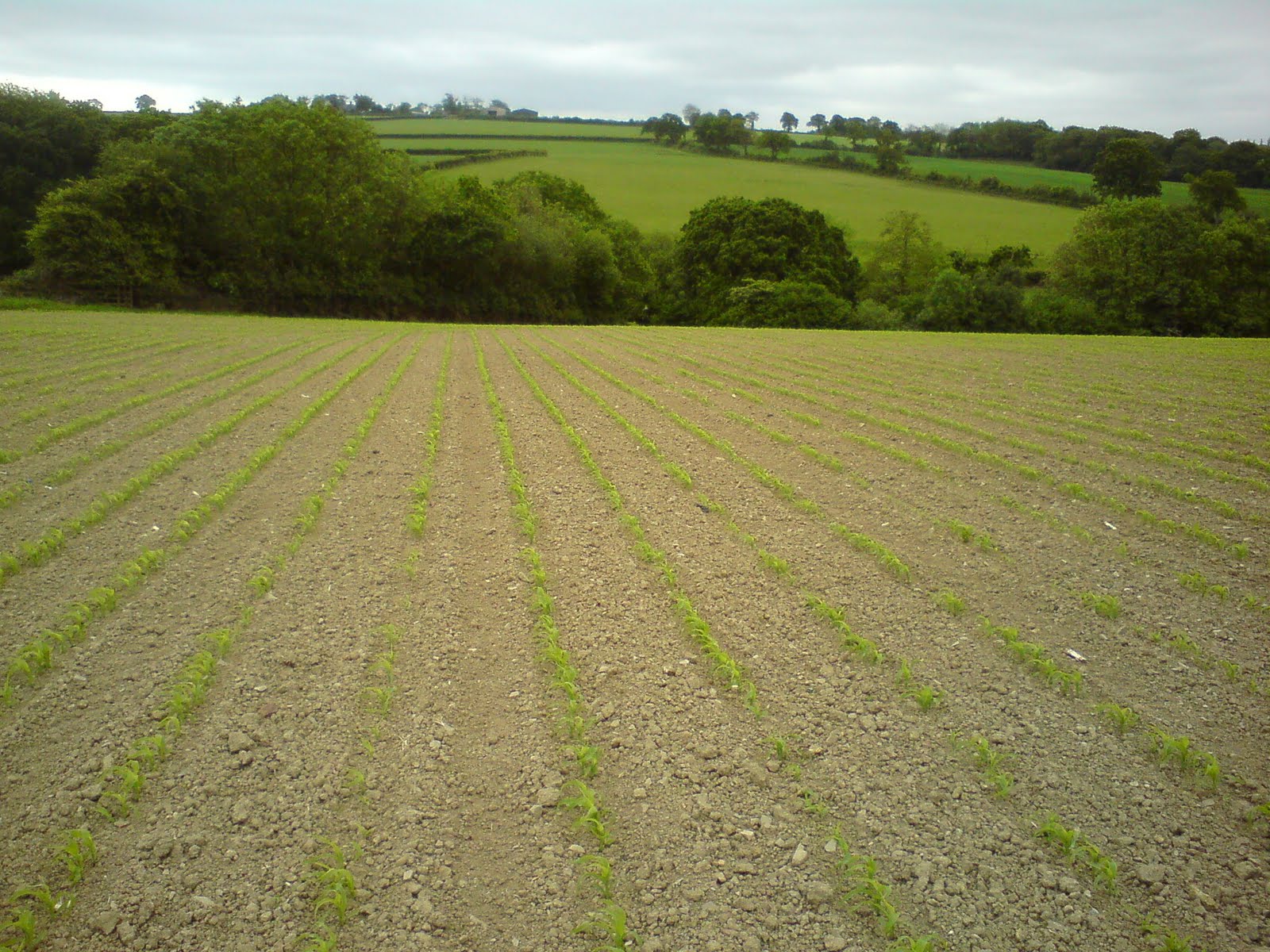 |
| Germination generally was good., but on heavier ground it was patchy. Near Ashwater. |
 |
| Beethoven standing like soldiers, near Launceston |
 |
| The prolonged wet spell in June (just after the declaration of a drought) along with cool damp windy conditions started to encourage eyespot formation and spread on 2nd year maize ground. This taken on 24th June, way earlier than thought normal caught a lot of people off guard with a lot of people advising not to spray as it was too early...? |
 |
| Later drilled maize really struggled to germinate due to the dry conditions, then struggled with the cold dry windy conditions which was then further exaccerbated by the cool wet windy conditions in June and July. Not good! |
 |
| On south facing, warm, more sheltered fields the maize kept on growing, albeit slowly. |
 |
| The dry, cool, conditions early on meant weeds didn't germinate, or came up sporadically meaning spray timings were tricky. On top of this, the very windy conditions made this even more difficult with windows extremely tight, a lot of the time being missed resulting in situations like the above. These conditions lead to applications being apllied later than ideal with resulting leaf scorch, stunting etc. |
 |
| Leaf scorch after late spraying. |
 |
| Desperate situation. |
 |
| Eyespot continued to spread whilst spray advisors held off spraying..... |
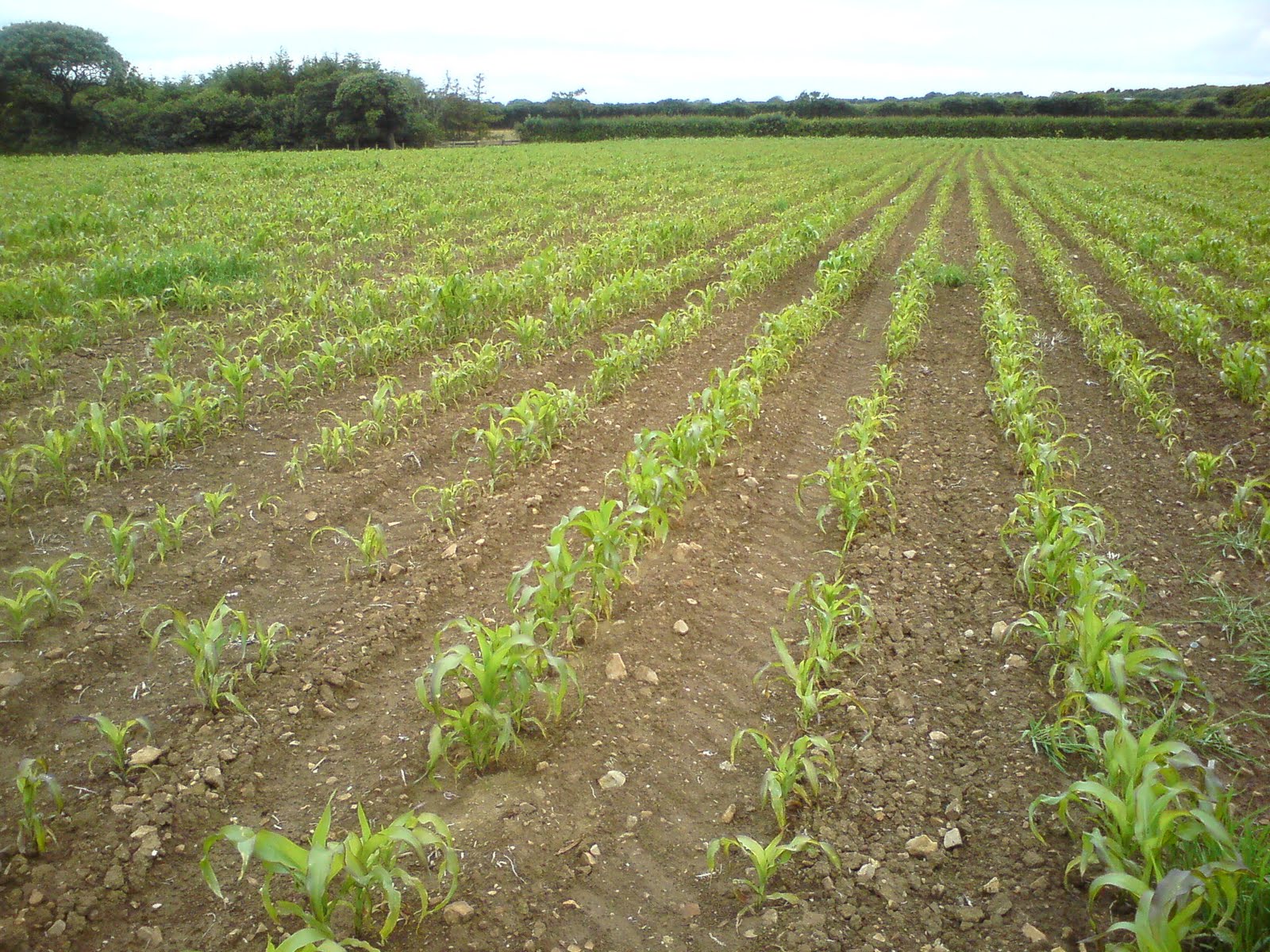 |
| 15th July and not looking very good, the cool dry conditions meant soil temps were low, root growth and nutrient uptake poor, foliar feed sprays with P&K, Zn, Mo, Cu, Mn and S definitelly helped rescue the situation. |
 |
| Plant development by 15th July in the poorest fields near Holsworthy. This crop was drilled 20th April, in a field that was 5th year in maize, quite exposed to south westerly wind, but not the worst maize ground by any means. Shows what cool, dry windy conditions do to maize. |
 |
| 3 weeks after initial eyespot discovery and the leaf areas effected were drastically worse. This stimulated action on the spraying front, albeit late! |
 |
| Eyespot effected plant. |
 |
| 20th July and Eyepot is serious where not sprayed early. |
 |
| New variety Ambition, alongside Beethoven. The way the leaves grow more erect in Ambition makes it look more impressive, however the tops of the funnels are roughly the same height. Ambition is a slightly earlier maturing variety that has promise, supposedly yielding as well as Beethoven which is the highest yielding variety in marginal areas. |
 |
| Eyespot getting up onto the top leaves now, 20th July. |
 |
| Fieldscale photo showing how it spreads from focii. |
 |
| The effect of wind on growth, plants at least 6 inches taller where protected by sheltered area of the hedge. |
 |
| Not the tallest maize plant, but eyespot on all leaves. Early treatment, not planting more than 2 crops on the trot, and warm dry weather all help in preventing Eyespot. |
 |
| Lorado cob taken from field at Bude. Lorado (for grain) was planted 15th April. The other cob is from a crop near Holsworthy, planted 10th of May, don't know what variety it is, but as at 20th September this cob has no real grain development at all. As that process normally takes 10 weeks in average conditions from August through to early October, the chances of any starch being laid down are very poor, given we are now in cooler temperatures and shortening daylight hours and potential night frosts. All in all, the situation for the white cob maize is pretty dire. This raises some very important questions about what to do now. The grower has a very large dairy herd, the ground is prone to getting wet and sticky fairly quickly, it's in a catchment sensitve area not far from major water courses. Does he wait till November in hope that he gets some starch development and run the risk of causing potentially severe soil run-off into the water courses, or take it earlier whilest ground conditions are better with little starch and green and try and chop it and preserve it in the clamp as best he can? Hobsons choice? |
More photo's will follow, but what is really clear this year is that those who planted when the conditions were right, not by calendar date have the better crops as they were able to get away early, get roots developed so that when the conditions became adverse, the plants were better able to cope.
Today, 20th September, the weather has been wet, mizzly and generally more like a November day than normal, the ground is wet, soaked right through, travelling conditions are poor and it is going to require a good period of dry weather to enable maize plants to dry down and reach maturity. My fear is that having seen such variability in fields from uneven germination, judging the right time to harvest is going to be judged more by traveling conditions and a desire to get the crop in the pit, than when the crop is fit to cut. Another factor at this minute in time is the weather, it really is favouring eyespot development and spreading, if it continues in the same vein for a week like it was today, the plants are going to be dead from the disease in 2 weeks anyway, with the result that starch levels won't increase much as the plants won't be photosynthesising. Waiting till November for the plants to die off and thereby try and raise the drymatter is not really going to help either, the cobs won't mature anyway if there is no green leaf area. The only thing to do will be to cut it and make provisions for possibly acidic silage and additional effluent, which can be mitigated by using chopped straw, or better still, chopped sugarbeet on the floor of the pit to soak it up. The other risk from leaving plants badly effected by eyespot in the field for a protracted period in the hope of raising drymatter levels is the increased rick of afflotoxins developing, Fusarium in particular, which will effect cows ferility and general well being far more than feeding a bit of acid silage. At least the acidity can be buffered, afflotoxins will do far more and longer term damage to cow health and milk yield than acidity, so trying to harvest brown paper like maize is NOT a good idea. 30% drymatter and 30% starch is going to be good down here this year, 25% I think is going to be more likely the norm this year.
Another very important consideration from now on for anyone farming in a catchment sensitive area is that the Environment Agency are going to be utilising existing legislation to prosecute and enforce best management practice with relation to run-off, soil sedimentation/siltation from fields that polute/ silt up watercourses. The legislation is already there, be warned, they will not be as tolerant with people who grossly flout the rules. As the main man from the EA said at the MGA meeting, it's like speeding, doing 80mph on the motorway, you'll probably get a caution, doing 60mph in a 30mph zoine past a school, they will through the book at you and it will go strait to court! Dragging very muddy vehicles/trailers out onto roads/tracks right next to watercourses, not chisseling the maize stubbles right behind the harvester to reduce surface run-off and soil erosion if they are to be overwintered are going to be hotly monitored in the South West and other catchment sensitive areas. The EA will be monitoring from the air too, they have the aircraft standing by, they will be able to pinpoint exactly where the problems arise,photograph it and present the evidence, so it is in everyones best interest if the principles set out on the MGA site, in the DEFRA Soil Management Guide, as well as other sources are adhered to.
Saturday, 16 July 2011
Wheat......Update on Demo plots.
The Cereals Event has been and gone, lots of flashy paint, plant and toys to entice anyone to part with a serious load of wedge/notes (depending from which side you come from). Lots of fancy stuff in the agchem arena and equally large and expensive machinery to apply it with. It seems every year the prices of these tools become ever more stratopheric, if inflation is supposed to be in the very low single digits, then you need a stiff drink and a new set of glasses to fathom the price increases in four wheeled machinery!
There has been a lot of comment in the farming press lately about wheat variety selections for the 2012 season, with emphasis as always being placed on the new upcoming varieties that have made the recommended list(RL). I personally have some misgivings about the way the list is put together, because I think that it doesn't always reflect what is actually happening with varieties in different regions, indeed soil types, even though there are North, South, East and West specifics. How does a wheat perform say on heavy wet land in Devon (when the land the RL trials are conducted on is light free draining reds near Exeter). Likewise, ground in Dorset differs markedly from that in Kent, yet both count as South.
The RL trials are littered with the corpses of varieties that supposedly never made it onto the list because they failed, or were inconsistent over a multitude of sites. A classic example of this is a Nickerson bred variety called Lear, a variety way ahead in yield when it came out, Orange Blossom Midge resistance, superior septoria and rust resistance, fantastic grain quality and a good amount of straw, everything you could want in a western wheat. It didn't make the list because apparently it had weak straw. Well, tell that to the farmers who are growing it and getting exceptional yields from it! I remember Bill our wheat breeder reflecting that he should have fought harder to get it approved as it was a very good variety, however because of the process, not all candidates make it, so they were sanguine about it at the time, but regret it now. Commercial seed stocks are very limited as very few grow it. Likewise Deben now, supposedly outclassed by the newer varieties on the RL. Last but not least, Istabraq, dropped from the RL trials program now, considered an 'old' variety, but in last years trials at Exeter was joint top yielder at 118% with the highest specific weight. Go to Scotland, like I just have this week and you will see Istabraq outperforming the newer wheats hands down in the field, still the best distilling variety out there. Then there's Alchemy, still at 112% at Exeter last year, 4th highest yielder ahead of a lot of newer RL stuff, but supposedly outclassed by these same varieties on the printed RL books. To me, consistency of yield is more important than one years performance and knowing the genetic parentage of a variety is a vital clue to this consistency.
So this begs the question, why are we seeing a 3% yield increase roughly year on year in the RL system, but this is not being translated to farm level. Last year, someone I know in Wiltshire averaged 11.2t/ha (sold!)over 350Ha growing Solstice, Claire and Duxford(2nd wheat slot). You don't have to be a mathematician to appreciate the profitability of growing high yielding milling and feed wheats when wheat is trading at nearly £200/ton. Claire is 12 years plus old, yet it is still more than capable of producing good yields, even in difficult places like North Devon, so why are there people out there slating it and saying it's getting old and falling behind newer varieties? Is the process of selection producing varieties of high potential yield, but with poor to mediocre specific weights and hagbergs, which will sprout if you sneeze on them at harvest time? Are breeders, as a result of the RL system, being tempted to make quality sacrifices in genetic resistance to disease by releasing varieties with only single gene, rather than polygenic resistance factors, which then break down only a year or two after being released, or even whilst still in the trials stages? Is the drive by big chemical companies that are buying up small to medium scale cereal breeding companies limiting diversity of research? My fear is that this 'race' to release new varieties is leading us down a blind alley, where more and more genetic material is 'burnt' as varieties break down to rusts etc and resistant genes become fewer and fewer to the point that genetic modification becomes the only road available to maintain wheat production.
Is the new chemistry that is being applied to varieties negating yield performance in the field, are some of these tank mixes that are being put together actually depressing the plants abilities through phytotoxicity? How many farmers/agronomists are actually applying recommended rates and mixes as stipulated by manufacturers? Did you know that Nickerson tests a full range of different fungicide programs from different maufacturers over the course of a candidate variety going through the NL and RL processes, which once approved is freely available so growers can see which spray program produces the best result for that specific variety. I asked a very successful farmer this the other evening at one of my demonstration events, to which he replied no, never knew it, never seen them, his agronomist had never given him one. http://www.nickersondirect.co.uk/products/winter_wheat1.html Check for yourself, the info is here and if it's not, then I sure can find it.
So, after all that, have a look at what these wheat varieties down near Tregony in Cornwall look like, some good, some not so good, lots to learn and observe, this has really been a 'shake-out' year for many wheat varieties and we aren't done yet! Have a look at the wheat near the end of the plots next to Duxford, This is Nickerson Original Deben treated with GPA. Looks better than a lot of the material in the plots, it will be very interesting to compare its yield to the ordinary Deben in the plots and the other varieties. Then there's Stigg, maybe not everyones cup of tea, but it does point the way we need to be looking for septoria resistance!
There has been a lot of comment in the farming press lately about wheat variety selections for the 2012 season, with emphasis as always being placed on the new upcoming varieties that have made the recommended list(RL). I personally have some misgivings about the way the list is put together, because I think that it doesn't always reflect what is actually happening with varieties in different regions, indeed soil types, even though there are North, South, East and West specifics. How does a wheat perform say on heavy wet land in Devon (when the land the RL trials are conducted on is light free draining reds near Exeter). Likewise, ground in Dorset differs markedly from that in Kent, yet both count as South.
The RL trials are littered with the corpses of varieties that supposedly never made it onto the list because they failed, or were inconsistent over a multitude of sites. A classic example of this is a Nickerson bred variety called Lear, a variety way ahead in yield when it came out, Orange Blossom Midge resistance, superior septoria and rust resistance, fantastic grain quality and a good amount of straw, everything you could want in a western wheat. It didn't make the list because apparently it had weak straw. Well, tell that to the farmers who are growing it and getting exceptional yields from it! I remember Bill our wheat breeder reflecting that he should have fought harder to get it approved as it was a very good variety, however because of the process, not all candidates make it, so they were sanguine about it at the time, but regret it now. Commercial seed stocks are very limited as very few grow it. Likewise Deben now, supposedly outclassed by the newer varieties on the RL. Last but not least, Istabraq, dropped from the RL trials program now, considered an 'old' variety, but in last years trials at Exeter was joint top yielder at 118% with the highest specific weight. Go to Scotland, like I just have this week and you will see Istabraq outperforming the newer wheats hands down in the field, still the best distilling variety out there. Then there's Alchemy, still at 112% at Exeter last year, 4th highest yielder ahead of a lot of newer RL stuff, but supposedly outclassed by these same varieties on the printed RL books. To me, consistency of yield is more important than one years performance and knowing the genetic parentage of a variety is a vital clue to this consistency.
So this begs the question, why are we seeing a 3% yield increase roughly year on year in the RL system, but this is not being translated to farm level. Last year, someone I know in Wiltshire averaged 11.2t/ha (sold!)over 350Ha growing Solstice, Claire and Duxford(2nd wheat slot). You don't have to be a mathematician to appreciate the profitability of growing high yielding milling and feed wheats when wheat is trading at nearly £200/ton. Claire is 12 years plus old, yet it is still more than capable of producing good yields, even in difficult places like North Devon, so why are there people out there slating it and saying it's getting old and falling behind newer varieties? Is the process of selection producing varieties of high potential yield, but with poor to mediocre specific weights and hagbergs, which will sprout if you sneeze on them at harvest time? Are breeders, as a result of the RL system, being tempted to make quality sacrifices in genetic resistance to disease by releasing varieties with only single gene, rather than polygenic resistance factors, which then break down only a year or two after being released, or even whilst still in the trials stages? Is the drive by big chemical companies that are buying up small to medium scale cereal breeding companies limiting diversity of research? My fear is that this 'race' to release new varieties is leading us down a blind alley, where more and more genetic material is 'burnt' as varieties break down to rusts etc and resistant genes become fewer and fewer to the point that genetic modification becomes the only road available to maintain wheat production.
Is the new chemistry that is being applied to varieties negating yield performance in the field, are some of these tank mixes that are being put together actually depressing the plants abilities through phytotoxicity? How many farmers/agronomists are actually applying recommended rates and mixes as stipulated by manufacturers? Did you know that Nickerson tests a full range of different fungicide programs from different maufacturers over the course of a candidate variety going through the NL and RL processes, which once approved is freely available so growers can see which spray program produces the best result for that specific variety. I asked a very successful farmer this the other evening at one of my demonstration events, to which he replied no, never knew it, never seen them, his agronomist had never given him one. http://www.nickersondirect.co.uk/products/winter_wheat1.html Check for yourself, the info is here and if it's not, then I sure can find it.
So, after all that, have a look at what these wheat varieties down near Tregony in Cornwall look like, some good, some not so good, lots to learn and observe, this has really been a 'shake-out' year for many wheat varieties and we aren't done yet! Have a look at the wheat near the end of the plots next to Duxford, This is Nickerson Original Deben treated with GPA. Looks better than a lot of the material in the plots, it will be very interesting to compare its yield to the ordinary Deben in the plots and the other varieties. Then there's Stigg, maybe not everyones cup of tea, but it does point the way we need to be looking for septoria resistance!
Tuesday, 24 May 2011
Grassland and Muck 2011
This is the first time I have been on the stand at this event and what an event it was, those of you who missed it really did miss a very good show, even if the weather on the first day was fickle.
Nickerson has been doing this show for a long time and as usual it didn't disappoint as Simon Broddle had spent a lot of time and energy making sure it had plenty for people to look at and discuss. No point in showing things in photo's if you can root around and actually see the practical benefits 'hands on' so to speak.
The one display that got most people talking and thinking was the 'Broadcast vs Drilled' circle. The mix was Blue Circle, a 10 year ley with a good spread of early, intermediates, and late perrenial ryegrasses and a mix of small, medium and large leafed white clovers. The plot was broadcast and drilled (half : half) at the standard 14kgs/ac rate, the drilled piece being drilled with an amenity drill on 2" row spacings. A conventional cereal type drill would have much wider rows and would have accentuated the problems even further.
Visually, the broadcast part looked shorter and there were far fewer heading plants, whilst the drilled part looked more impressive with taller heading varieties. However when you got up close and looked into both swards, the drilled part was much thinner, there was more weed species visible which were growing in the gaps between the drilled rows, the species of grass in these rows were virtually all tetraploid and hybrid species of ryegrass, the clovers were mostly long petiole large leafed, with little of the smaller white clovers surviving. Basically, the drilled lines had squeezed out all the diploid types, along with the medium and small clovers, completely altering the nature of the sward from a longterm ley to a medium term one more suited to cutting than grazing with sheep and cattle. The same thing happens when you plant grass seeds too deep! The broadcast part on the otherhand was thick, like a carpet, had all the species in the mix present and had produced 400kg/ha DryMatter (DM) more than the drilled part. Over a season this would equate to nearly a tonne of DM more for the broadcast part than the drilled portion. This difference is worth the cost of the seed, in the first year alone! Makes you think.....
Click on the pictures to see it in full size, they're not the clearest one I know, but it shows what I have been talking about above.


Nickerson has been doing this show for a long time and as usual it didn't disappoint as Simon Broddle had spent a lot of time and energy making sure it had plenty for people to look at and discuss. No point in showing things in photo's if you can root around and actually see the practical benefits 'hands on' so to speak.
The one display that got most people talking and thinking was the 'Broadcast vs Drilled' circle. The mix was Blue Circle, a 10 year ley with a good spread of early, intermediates, and late perrenial ryegrasses and a mix of small, medium and large leafed white clovers. The plot was broadcast and drilled (half : half) at the standard 14kgs/ac rate, the drilled piece being drilled with an amenity drill on 2" row spacings. A conventional cereal type drill would have much wider rows and would have accentuated the problems even further.
Visually, the broadcast part looked shorter and there were far fewer heading plants, whilst the drilled part looked more impressive with taller heading varieties. However when you got up close and looked into both swards, the drilled part was much thinner, there was more weed species visible which were growing in the gaps between the drilled rows, the species of grass in these rows were virtually all tetraploid and hybrid species of ryegrass, the clovers were mostly long petiole large leafed, with little of the smaller white clovers surviving. Basically, the drilled lines had squeezed out all the diploid types, along with the medium and small clovers, completely altering the nature of the sward from a longterm ley to a medium term one more suited to cutting than grazing with sheep and cattle. The same thing happens when you plant grass seeds too deep! The broadcast part on the otherhand was thick, like a carpet, had all the species in the mix present and had produced 400kg/ha DryMatter (DM) more than the drilled part. Over a season this would equate to nearly a tonne of DM more for the broadcast part than the drilled portion. This difference is worth the cost of the seed, in the first year alone! Makes you think.....
Click on the pictures to see it in full size, they're not the clearest one I know, but it shows what I have been talking about above.

The upshot of this stand display was one farmer cancelling his newly ordered grass drill which he confessed to buying earlier in the day as 'all the farmers and contractors around us are using these drills now and we thought they looked like there were doing a good job'. Having looked at this demonstration agast at the differences and losses, he cancelled the drill order......

The broadcast piece on the left, drilled to the right of the posts.
The show although suffering with a lack of grass through the drought, was very busy for us, the general consensus from people being it was well worth the effort to get to it. It was amusing to hear that even though there wasn't a lot of grass, they still managed to block the Krone BigX forager, the clip of which can be found here: http://www.youtube.com/watch?v=Bb2FSgt1zOA&feature=feedu
Subscribe to:
Posts (Atom)