Taking a 'holistic' approach to dairy management is allowing better returns to be made.
Growing a specialist variety of grain maize , as well as lucerne and grass and managing it according to specific advice from leading forage experts Nickerson Direct has resulted in North Cornwall farmers Michael and Anthony Grills being able to consolidate and expand their dairy enterprise even in the face of price adversity.
Continuing pressure on the dairy industry has encouraged Michael and Anthony to focus on increasing efficiency and cost-effectiveness over the last few years, during which they have expanded their dairy business from 250 to 320 cows, with the eventual aim of reaching 500. They have also implemented major advances in genetics and nutrition, reduced costs, improved attention to detail and increased profitability.
Until 2009, cropping at West Trelay Farm, Marhamchurch included 60-80 acres of forage maize, which was included in the ration at the rate of one part to two parts grass silage. However, the Grills found it difficult to achieve consistently good results from forage maize and variability in the clamp made correct rationing difficult. Typical butterfat levels struggled to get to 4% on the wheat and barley mix as a starch source along with forage maize, which when on a cheese contract is costly.
In early 2009, Nickerson Direct Seed Specialist Simon Montgomery suggested that Michael and Anthony include grain maize with the forage maize as an additional energy source to supplement grass silage, its higher energy/starch content significantly improving milking performance and making the ration easier to manage throughout the year.
The initial crop produced an average of 5 tonnes per acre of grain which was put into the clamp for £68/t, making it very cost-effective. The maize fed tremendously well, with average butterfat content increasing from 3.98% to a maximum of 4.54% during the winter and never dropping below 4.2% the following summer, while protein remained at 3.18-3.21% throughout. The resulting increase in the quality of the milk, all of it contracted to Dairy Crest for cheese production, netted the Grills a 1p/litre quality premium worth £25,000 per year.
It was so successful that in 2010 they substituted the area of forage maize for grain maize, drilling 90 acres of Lorado between 18th and 21st April. The crop established quickly in favourable conditions, grew consistently throughout the season despite being subjected to severe drought stress and in terms of maturity behaved more like a Group 9 than its official NIAB Group 7 rating would suggest with harvest completed by 17th October and averaging a respectable 4.5 -5 t/ac in yield.
This year, the area was increased further, with a number of fields being 3rd year grain maize. 2011 started off far drier than 2010, with the crop being planted on the 14th and 15th April in ideal conditions. What was startling though on the light ground was how much moisture had been retained by the 2 previous years mulched stalks, allowing easy seed bed preparation and perfect planting conditions giving a very even plant establishment, something others struggled with this year. Herbicide applications also worked well. Even with the extremes of weather this year, first hot and dry, then cold and dry, followed by cool windy and wet conditions from 15th June onwards, the crop looked good.
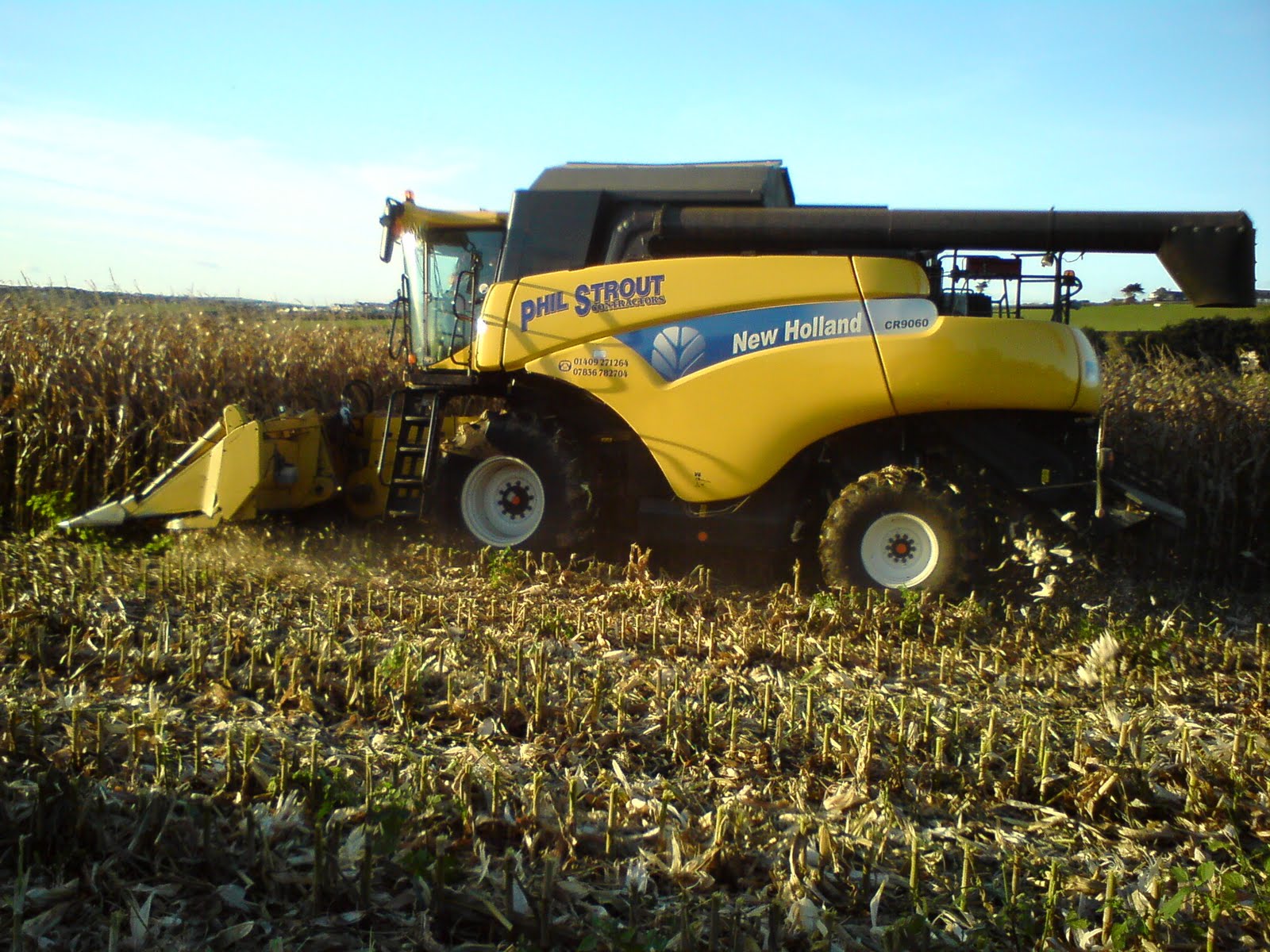
By the 11th October the crop was ready to harvest, even after the poor growing conditions this year, with contractor Phil Strout combining 4 - 5 tonnes per acre (at 30-34% moisture) of what Anthony Grills describes as ‘a wonderful product, like gold dust’, although he acknowledges that their location on relatively dry ground in North Cornwall favours the crop. The fact that Lorado dries down quickly, right to the base of the kernel, 'enables us to put it through the crimper efficiently, producing a gritty flour type product, even though we are adding water with the acid type preservative, which as a result has increased surface area allowing easy digestion in the cows' gut. We're also getting better protein values from the maize as a result of using this method. In doing so we are reducing the overall acid loading on the cows digestive system, which with good quality grass silage is making a noticeable difference'.
After appraising and careful consideration with Simon, a trial field of Lucerne was planted in one of the drier fields 'to see what happens'. Simon's past experience of growing Lucerne in Zimbabwe helped in getting a fantastic establishment in difficult dry conditions. The first cut was made mid July, being left to wilt for 4 days with one turning with an old Vicon Acrobat doing the job very well without losing the leaf, before row up and baling. The Lucerne was chopped as being baled, resulting in very dense, tightly packed bales which had an additional layer of plastic to stop any 'porcupine effect'. The resultant forage has surpassed expectations. The second cut in early September was done the same way and has analysed equally well, yielding similarly at 8 600kg bales per acre. Next year, four cuts should be easily achievable.
Sowing Lucerne near Bude, 15th April 2011
Establishment is everything with lucerne.
Cutting and wilting properly, without loosing the leaves is critical
The inclusion of 1.5 kg per cow of Lucerne in the diet has raised protein levels from 3.18 to 3.35%. It has also allowed the removal 0.25kg per cow of soya from the ration, saving over £900/month in bought in soya cost. It has also helped boost butterfat levels which are now up to 4.64% in cows producing 10,000 litres of milk. The milk from forage figure is now standing at 4500 litres, from grazed grass and grass silage only, as the grain maize is treated as a concentrate.
What is noticeable too is how cow health is improving. Cows are very 'on the go'; alert, but contented and relaxed looking when you study them, they do not look tired and lethargic. They are showing better bulling signs and better holding post AI. As a result the cull cow numbers have reduced, calving index is improving, there is now a surplus of heifers being reared which is providing another good revenue stream to the business.
Soil management has also been appraised, some time ago soil conditioning fertilisers became part of the crop fertilising regime, recently the inclusion of 'bugs' into the slurry towers is enhancing nitrogen values by 18-20% with silage ground staying green after cutting, rather than the usual browning off period whilst swards recover. This has lead to a reduction in bought in Nitrogen fertiliser use over the whole farm, particularly in the grain maize fields, the flora and fauna levels in the soils as a result is improving along with soil structure.
The combination of crimped maize and Lucerne in the diet has added an additional 1.5p quality premium to their milk price, which is making the business far more viable. It is also providing the basis for a more balanced diet, with good quality grass silage under pinning it. 'Most importantly, the growing of grain maize at £70 per ton in the clamp, the improved milk price as a result of better quality milk, the savings from inclusion of Lucerne into the diet has stabilised the farm business, on the borrowings side and the new bank protocols, our business is more sound and is allowing us to push forward and further invest in our enterprise.
As Simon has said before, "Dry grain production requires varieties with rapid dry-down rates, harvested after the leaves have died back and typically followed by the removal of 10%-15% moisture in a dryer, which increases the cost of the final product and is a major factor in steering producers towards moist storage after crimping".
“The high energy content and slow starch degradation characteristics make crimped grain maize an ideal moist concentrate feed for high-performance dairy and beef animals. It is convenient and reliable, ideal for use on farms where maize silage area is limited but where additional starch is required in the diet. Typically, the nutrient analysis for crimped grain is 65%-75% Dry Matter, 12-13 ME, 9-11% crude protein and 60%-70% starch. What makes Lorado so good is that it typically has a protein value of 12.7%, much more than other varieties and this does make a big difference in the ration".
“Grain maize provides a much more concentrated form of energy than forage maize, which is very important in achieving the correct energy-density in rations, enabling cows to eat more and make more milk. It is also very convenient, allowing livestock farmers to ‘top up’ lower-quality forages and those who buy in straights to purchase the exact tonnage they require, as and when they need it, which benefits cash-flow.
“Many farmers have tried to produce grain maize using conventional forage varieties, but these will only dry down slowly to a minimum of 30% moisture, making the crop difficult to combine in often wet and windy conditions late in November or December. Growing specialist grain maize varieties will make a big difference, but producing a good crop requires a different technique in terms of variety, plant population, nitrogen management and timing".
“It is essential to choose the correct variety. Lorado was bred by Limagrain specifically to perform well in Northern Europe. It is one of the earliest-maturing varieties in the Maize Growers Association trials and under favourable conditions does not require covering with plastic. Despite being the tallest on the NIAB list, it has excellent standing power, good disease resistance, excellent early vigour and good cob tip cover, which eliminates the risk of mould infection from ‘snouting’. Lorado produces excellent yields of high-quality grain, has superb dry-down characteristics and will reach 25% moisture, making it easier to harvest.What growers don't always appreciate is that dry-down gets slower the later the crop gets into October, particularly when you start getting into November, whilst the ground and conditions typically are getting wetter! It sounds obvious, but I am seeing combines running down in the southwest in late November by which time white moulds, fusarium and cob rot are starting to really take hold. The whole idea should be to harvest as pure a form of starch as possible, yet by planting later maturing varieties, even under plastic, the resultant contamination risks are hugely increased, negating the advantages of inclusion in the diet. We are harvesting Lorado at Bude before most of the forage varieties are harvested, which gives some idea of just how early to mature it is".
“Grain maize crops should be sown as early in April as possible, when soil temperature reaches 8°C, into light, free-draining soils in South-facing fields that warm up quickly during the spring and drain well right through until harvest. Whereas crops grown for crimped maize production typically require a seed rate of 38,000-40,000 seeds/acre, for grain maize production this should be reduced to 36,000-38,000 seeds/acre.
“In addition to its many economic benefits, grain maize also has significant environmental benefits. The defra guidelines indicate that farmers should sow a green cover crop after harvesting forage maize to prevent soil erosion. With grain maize, however, this is not necessary as the stova is chopped and spread, creating a ‘mat’ that allows machinery to travel on the land more easily, greatly reducing soil erosion/run-off, improving soil structure and lowering the export of Phosphate and Potash from the field/farm, a big win-win situation given the current rising cost of fertiliser”.
Showing posts with label Lorado. Show all posts
Sunday, 8 January 2012
Farmers Guardian article December 2011
Labels:
Bude,
Combining Maize,
Crimped Maize,
Dairy nutrition,
Growing lucerne,
growing protein crops,
Holistic management,
LG 3193,
Lorado,
managing maize,
Nickerson Direct,
Simon Montgomery
Tuesday, 10 May 2011
Maize under plastic 2011 trial.
A customer of mine in Cornwall has finally decided to try out this maize-under-plastic method after being nagged and cajoled by his local contractor who has one of these special maize drills. This trial is for grain maize specifically, this system for forage maize is completely different and has some value in very unfavourable areas. Here are some photo's showing the results so far.
Drilled at the same time as the main crop which is Lorado, the earliest high yielding grain maize variety currently available. Please note the highlighted bit, I am not stating that it is the highest yielding variety, just that it's the earliest of the high yielders. This is an often overlooked factor when choosing grain maize varieties, outright yield is often the main selling point. I argue that it's no point growing this grain crop if you are expecting to harvest it in cold wet dark December, when the grain is more often than not contaminated by fusarium and other unpalatable moulds and diseases which spoil quality. Having a variety that will stand all the way through winter is hardly any advantage if the grain is rotten by then! Lorado is good in that it dries down very rapidly and is earliest to finish, when it's ready, don't hang around, go get it. If you wait, it will lodge just below the cob as previous post photo's show although grain loss is actually very small.
Lorado conventionally drilled next to Lorado under plastic. What is really interesting is that the Lorado is emerging better than the maize-under-plastic recommended varieties, as can be seen below.
Lorado emerging in these rows here very evenly and a lot more consistently.
Standard varieties in the first 10 lines, with Lorado on the outside 2 rows. Standard varieties really struggling to punch through the plastic compared to the Lorado.
One of the issues with this system of establishing maize in a dry year can be seen below. The rain has soaked in beautifully into the conventionally planted, but is bone dry under the plastic. The plants which haven't 'punched' through are under tremendous drought stress, are quite brittle in the stems and showing signs of damage. Bizarely the weeds under the plastic are flourishing as they have enough moisture to survive, even though this area has been sprayed with a pre-emergence herbicide. This can be seen in the photo's below.
Struggling to 'punch through' as it's claimed to.
Because the system of laying the plastic, spraying and drilling the seed is so task heavy and complicated, there is no way of banding a starter fertiliser into the seedbed. As a result, the plants have to scavenge for nutrients, something that maize does not do well. This I am sure is holding back growth and therefore inhibiting yield potential. The plants in the picture above this one if you look carefully are actually quite pale, compared to the plants planted conventionally, even though they are larger.
My main concern though looking at the picture above is weed control. Look at how big these weeds above are under the plastic, there is just no way of controlling these, you cannot over spray as the chemical will just land on the plastic sheet and maize just hates any weed competition. It's going to take a really impressive recovery from here to get me interested in spending an additional £160/ac over the conventionally grown grain maize.
Updates will follow, watch this space........
Labels:
Bude,
Grain Maize,
Lorado,
Maize-under-plastic,
Nickerson Direct,
Nickersons,
Simon Montgomery
Friday, 26 November 2010
South West Farmer Press release, for those that don't get this publication.
PRESS RELEASE
Specialist grain maize variety harvested ‘a month early’
25th October 2010
Growing a specialist variety of grain maize and managing it according to specific advice from leading grain maize experts Nickerson Direct has resulted in North Cornwall farmers Michael and Anthony Grills being able to start harvesting an excellent crop of Lorado on 14th October, four weeks earlier than traditional forage maize.
Continuing pressure on the dairy industry has encouraged Michael and Anthony to focus on increasing efficiency and cost-effectiveness over the last few years, during which they have expanded their dairy business from 250 to 320 cows, with the eventual aim of reaching 500. They have also implemented major advances in genetics and nutrition, reduced costs, improved attention to detail and increased profitability.
Until 2009, cropping at West Trelay Farm, Marhamchurch included 60-80 acres of forage maize, which was included in the ration at the rate of one part to two parts grass silage. However, the Grills found it difficult to achieve to achieve consistently good results from forage maize and variability in the clamp made correct rationing difficult.
In early 2009, Nickerson Direct Seed Specialist Simon Montgomery suggested that Michael and Anthony include grain maize with the forage maize as an additional energy source to supplement grass silage, its higher energy/starch content significantly improving milking performance and making the ration easier to manage throughout the year.
The initial crop produced an average of 5 tonnes per acre of grain which was put into the clamp for £68/t, making it very cost-effective. The maize fed tremendously well, with average butterfat content increasing from 4.1%-4.2% to a maximum of 4.54% during the winter and never dropping below 4.2% this summer, while protein remained at 3.34%-3.38% throughout. The resulting increase in the quality of the milk, all of it contracted to Dairy Crest for cheese production, netted the Grills a 1.25p/litre quality premium worth £35,000 per year.
It was so successful that this year they substituted the area of forage maize for grain maize, drilling 90 acres of Lorado between 18th and 21st April. The crop established quickly in favourable conditions, grew consistently throughout the season despite being subjected to severe drought stress and in terms of maturity behaved more like a Group 9 than its official NIAB Group 7 rating would suggest.
By the second week of October the crop was 12' high and ready to harvest, contractor Phil Strout combining 4.5-5 tonnes per acre (at 29%-34% moisture) of what Anthony Grills describes as ‘a wonderful product, like gold dust’, although he acknowledges that their location on relatively dry ground in North Cornwall favours the crop.
Simon Montgomery states: “In recent years, livestock farmers looking to increase their range of home-grown concentrates and arable growers looking for a spring-sown cash crop have shown an increasing interest in grain maize.
“Dry grain production requires varieties with rapid dry-down rates, harvested after the leaves have died back and typically followed by the removal of 10%-15% moisture in a dryer, which increases the cost of the final product and is a major factor in steering producers towards moist storage after crimping.
“The high energy content and slow starch degradation characteristics make crimped grain maize an ideal moist concentrate feed for high-performance dairy and beef animals. It is convenient and reliable, ideal for use on farms where maize silage area is limited but where additional starch is required in the diet. Typically, the nutrient analysis for crimpled grain is 65%-75% drymatter, 14.0%-14.5% ME, 8%-9% crude protein and 60%-70% starch.
“Grain maize provides a much more concentrated form of energy than forage maize, which is very important in achieving the correct energy-density in rations, enabling cows to eat more and make more milk. It is also very convenient, allowing livestock farmers to ‘top up’ lower-quality forages and those who buy in straights to purchase the exact tonnage they require, as and when they need it, which benefits cash-flow.
“Many farmers have tried to produce grain maize using conventional forage varieties, but these will only dry down slowly to a minimum of 30% moisture, making the crop difficult to combine in often wet and windy conditions late in November or December. Growing specialist grain maize varieties will make a big difference, but producing a good crop requires a different technique in terms of variety, plant population, nitrogen management and timing.
“It is essential to choose the correct variety. Lorado was bred by Limagrain specifically to perform well in Northern Europe. It is one of the earliest-maturing varieties in the Maize Growers Association trials and under favourable conditions does not require covering with plastic. Despite being the tallest on the NIAB list, it has excellent standing power, good disease resistance, excellent early vigour and good cob tip cover, which eliminates the risk of mould infection from ‘snouting’. Lorado produces excellent yields of high-quality grain, has superb dry-down characteristics and will reach 25% moisture, making it easier to harvest.
“Grain maize crops should be sown as early in April as possible, when soil temperature reaches 8°C, into light, free-draining soils in South-facing fields that warm up quickly during the spring and drain well right through until harvest. Whereas crops grown for crimped maize production typically require a seed rate of 38,000-40,000 seeds/acre, for grain maize production this should be reduced to 36,000-38,000 seeds/acre.
“In addition to its many economic benefits, grain maize also has significant environmental benefits. The defra guidelines indicate that farmers should sow a green cover crop after harvesting forage maize to prevent soil erosion. With grain maize, however, this is not necessary as the stova is chopped and spread, creating a ‘mat’ that allows machinery to travel on the land more easily, greatly reducing soil erosion/run-off, improving soil structure and lowering the export of Phosphate and Potash from the field/farm, a big win-win situation given the current rising cost of fertiliser.”
Specialist grain maize variety harvested ‘a month early’
25th October 2010
Growing a specialist variety of grain maize and managing it according to specific advice from leading grain maize experts Nickerson Direct has resulted in North Cornwall farmers Michael and Anthony Grills being able to start harvesting an excellent crop of Lorado on 14th October, four weeks earlier than traditional forage maize.
Continuing pressure on the dairy industry has encouraged Michael and Anthony to focus on increasing efficiency and cost-effectiveness over the last few years, during which they have expanded their dairy business from 250 to 320 cows, with the eventual aim of reaching 500. They have also implemented major advances in genetics and nutrition, reduced costs, improved attention to detail and increased profitability.
Until 2009, cropping at West Trelay Farm, Marhamchurch included 60-80 acres of forage maize, which was included in the ration at the rate of one part to two parts grass silage. However, the Grills found it difficult to achieve to achieve consistently good results from forage maize and variability in the clamp made correct rationing difficult.
In early 2009, Nickerson Direct Seed Specialist Simon Montgomery suggested that Michael and Anthony include grain maize with the forage maize as an additional energy source to supplement grass silage, its higher energy/starch content significantly improving milking performance and making the ration easier to manage throughout the year.
The initial crop produced an average of 5 tonnes per acre of grain which was put into the clamp for £68/t, making it very cost-effective. The maize fed tremendously well, with average butterfat content increasing from 4.1%-4.2% to a maximum of 4.54% during the winter and never dropping below 4.2% this summer, while protein remained at 3.34%-3.38% throughout. The resulting increase in the quality of the milk, all of it contracted to Dairy Crest for cheese production, netted the Grills a 1.25p/litre quality premium worth £35,000 per year.
It was so successful that this year they substituted the area of forage maize for grain maize, drilling 90 acres of Lorado between 18th and 21st April. The crop established quickly in favourable conditions, grew consistently throughout the season despite being subjected to severe drought stress and in terms of maturity behaved more like a Group 9 than its official NIAB Group 7 rating would suggest.
By the second week of October the crop was 12' high and ready to harvest, contractor Phil Strout combining 4.5-5 tonnes per acre (at 29%-34% moisture) of what Anthony Grills describes as ‘a wonderful product, like gold dust’, although he acknowledges that their location on relatively dry ground in North Cornwall favours the crop.
Simon Montgomery states: “In recent years, livestock farmers looking to increase their range of home-grown concentrates and arable growers looking for a spring-sown cash crop have shown an increasing interest in grain maize.
“Dry grain production requires varieties with rapid dry-down rates, harvested after the leaves have died back and typically followed by the removal of 10%-15% moisture in a dryer, which increases the cost of the final product and is a major factor in steering producers towards moist storage after crimping.
“The high energy content and slow starch degradation characteristics make crimped grain maize an ideal moist concentrate feed for high-performance dairy and beef animals. It is convenient and reliable, ideal for use on farms where maize silage area is limited but where additional starch is required in the diet. Typically, the nutrient analysis for crimpled grain is 65%-75% drymatter, 14.0%-14.5% ME, 8%-9% crude protein and 60%-70% starch.
“Grain maize provides a much more concentrated form of energy than forage maize, which is very important in achieving the correct energy-density in rations, enabling cows to eat more and make more milk. It is also very convenient, allowing livestock farmers to ‘top up’ lower-quality forages and those who buy in straights to purchase the exact tonnage they require, as and when they need it, which benefits cash-flow.
“Many farmers have tried to produce grain maize using conventional forage varieties, but these will only dry down slowly to a minimum of 30% moisture, making the crop difficult to combine in often wet and windy conditions late in November or December. Growing specialist grain maize varieties will make a big difference, but producing a good crop requires a different technique in terms of variety, plant population, nitrogen management and timing.
“It is essential to choose the correct variety. Lorado was bred by Limagrain specifically to perform well in Northern Europe. It is one of the earliest-maturing varieties in the Maize Growers Association trials and under favourable conditions does not require covering with plastic. Despite being the tallest on the NIAB list, it has excellent standing power, good disease resistance, excellent early vigour and good cob tip cover, which eliminates the risk of mould infection from ‘snouting’. Lorado produces excellent yields of high-quality grain, has superb dry-down characteristics and will reach 25% moisture, making it easier to harvest.
“Grain maize crops should be sown as early in April as possible, when soil temperature reaches 8°C, into light, free-draining soils in South-facing fields that warm up quickly during the spring and drain well right through until harvest. Whereas crops grown for crimped maize production typically require a seed rate of 38,000-40,000 seeds/acre, for grain maize production this should be reduced to 36,000-38,000 seeds/acre.
“In addition to its many economic benefits, grain maize also has significant environmental benefits. The defra guidelines indicate that farmers should sow a green cover crop after harvesting forage maize to prevent soil erosion. With grain maize, however, this is not necessary as the stova is chopped and spread, creating a ‘mat’ that allows machinery to travel on the land more easily, greatly reducing soil erosion/run-off, improving soil structure and lowering the export of Phosphate and Potash from the field/farm, a big win-win situation given the current rising cost of fertiliser.”
Labels:
Bude,
Combining Maize,
Grain Maize,
Lorado,
Nickerson Direct,
Simon Montgomery
Tuesday, 2 November 2010
Video tour of my Launceston Maize trial plots.
Here it is, there are other clips on my youtube site too, more to follow.
Generally, these trials were very good this year, soil structure improvements carried out early to improve root development, the application of chicken manure as well as getting a good fine tilth all helped with the establishment and early growth which is vital with maize. Sometimes, the importance of leaf area index is forgotten, it is vital with maize and this is where vigour comes in as it is this ability to keep growing in less than ideal situations that means that when peak sunlight and heat units arrive in June and July you want a plant with a big enough leaf area to be able to absorb it all and to grow quickly! Beethoven is a variety that is able to do this.
Labels:
Beethoven,
Forage maize,
LG3181,
LG3215,
Lorado,
Maize trial,
Nescio,
Nickerson Direct,
Simon Montgomery
Thursday, 21 October 2010
Combining Lorado at Bude
Labels:
Bude,
Combining Maize,
Lorado,
Nickerson Direct,
Nickersons,
Simon Montgomery
It's all happening!!!
Maize foraging is in progress, most of it is off, although a lot I think has been cut before it was fully fit, but the weather has been kind and the general feeling has been 'get it while you can'.
Lorado, the only early grain variety out there surprised us all by being ready as early as the 11th of October in some fields, the bulk being ready by the end of the week of the 16th, yields have been very promising, (even though the population was slightly higher than it should have been) at around an average of 5ton/ac at 32% moisture content. Very satisfactory.
Here are some pictures and video of the crop coming in.
Labels:
Bude,
Combining Maize,
Lorado,
Nickerson Direct,
Nickersons,
Phil Strout,
Simon Montgomery
Thursday, 15 July 2010
Maize 2010 so far.
Cold, dry and a late start for many, although fortune so far has favoured the brave who planted early, got the crop started with the moisture that was already in the soil and then got rain just when needed to push the crops on. The predicted frost damage on early drilled fields has not yet materialised down here, even where drilled on the 16th of April when we had a week of hard frosts at the beginning of May.
Beethoven with it's fantastic early vigour has lead the pack in the trials right from the start, although Lorado in the last ten days has really started a serious growth spurt and has caught it up in terms of stature.
A lot of crops with average vigour have needed a trace element/foliar spray to get them growing in the very dry conditions, especially those planted in May which weren't able to get a big enough root area before the sun and dry weather started to make life difficult for the small plants.
Contrary to MGA advice about cloddy seedbeds being OK, this has proved to be bad advice on heavier ground this year with very poor germination and plant counts where these types of seedbeds have been found. This may be OK on light loams and sands, but not on heavier clay loams in Devon and Cornwall. Compaction too has been a real issue on ground that was compacted in the wet last autumn with the tracks stil being visible this year, even after numerous passes with subsoilers and cultivators.
Going on growth stages, this year the crop on average is about 10 days ahead of where it was at the same time last year with a crop of Beethoven near Bude over 6ft tall at the end of June!
Labels:
Beethoven,
Bude,
Forage maize,
Lorado,
Maize trial,
Nickerson Direct,
Nickersons,
Simon Montgomery
Tuesday, 30 March 2010
Grain Maize at Bude, Cornwall.
Bude is one of the few places in Cornwall and Devon that grain maize can be grown without the excessive cost of using plastic to force the crop. It is not a favourable area in the NIAB/MGA sense at all though, so site choice is crucial as wind is a major factor in any site being considered for growing grain maize.
Below photo's of Lorado 2 weeks off combining, or when combining should have been done! Photo taken 7th October.

Below photo's of Lorado 2 weeks off combining, or when combining should have been done! Photo taken 7th October.
Two growers tried it in 2009, one had much better results than the other, one was being grown as a concentrate source in preference to Spring Wheat, the other as a cash crop. The concentrate crop was to be crimped and clamped, whilst the other was to be dried and sold at 15%MC.
One of the risks of combining maize is being able to harvest the crop early enough before the onset of the wet weather in November. Both growers crops were ready to combine in October, however for various reasons this didn't happen. Sure enough on Saturday the 7th of November the first winter storm blew in, deluging 3 inches of rain with 45mph winds in 4 hours between 6 and 10pm that night, with the results seen below.
Photo's below taken 9th November.
Even after this setback with the weather, the concentrate crop still averaged over 4.5t/ac, even though 4 ac were lost and not cut. It was telling that the crop was actually too dry when it was being crimped as water had to be added to aid the crimping process. However, the result worked in the farmers favour with 330 tonnes being crimped at a cost of £70/ton in the clamp, still a lot cheaper than bought in wheat and a far better feed. The actual advantage has turned the enterprise around with grian maize now being grown instead of forage maize as the one thing it does provide is a very stable diet platform for the cows.
Labels:
Graim Maize,
Lorado,
Nickerson Direct,
Simon Montgomery
Maize Trial Pt 2
Fresh weight yields for the varieties was as follows;
Acclaim 14.8t/ac
LG 3181 17.8t/ac
Lorado 18.4t/ac
LG3193 18.9t/ac
Beethoven 22.3t/ac
Nescio 22.7t/ac
Award 19. 2t/ac
Starch yields were a bit more interesting as can be seen from some of the cob photo's below and didn't follow the pattern of yield above in some instances.


Acclaim (4 rows in middle above) being the earliest to maturity had the highest dry matter (36%), but lowest ratio of starch to fresh weight, even though the plants were much shorter than the rest by a good 12 to 30 inches. Award had the lowest dry matter and was only at 22% DM when harvested.

Acclaim on left, LG3181 middle.
Whole cob weight (sheaves removed) averages as follows:
Acclaim 210 grams
LG 3181 270 grams
Lorado 270 grams
LG3193 236 grams
Beethoven 258 grams
Nescio 268 grams
Award 220 grams
What is interesting to note is that Beethoven and Nescio both combined very high yields in tonnage terms with a good average cob weight and when analysed gave readings of 32 %DM/34% Starch and 29%DM and 33% Starch respectively.

Beethoven left, Lorado right of knife.
LG3181 and Lorado both surprised with quick dry down, large cobs and high starch contents, facts which have been born out by similar merchant trials at Tregony where LG3181 had the highest starch return/ac of all varieties on trial and Lorado the highest return at a big trial at Launceston. This is also consistent with national trials for grain maize where both these varieties have come top for grain yield vs DM, both yielding over 8.4 ton/ha at 15 % moisture content.
Lorado and LG3181 were also both grown in a trial a mile down the road with Kingdom and both outyielded it by some margin, with Lorado doing the best of the three. This variety wiill be covered more in the section on grain maize where it performed well, even though the weather did wreak havoc.
Acclaim 14.8t/ac
LG 3181 17.8t/ac
Lorado 18.4t/ac
LG3193 18.9t/ac
Beethoven 22.3t/ac
Nescio 22.7t/ac
Award 19. 2t/ac
Starch yields were a bit more interesting as can be seen from some of the cob photo's below and didn't follow the pattern of yield above in some instances.
Acclaim (4 rows in middle above) being the earliest to maturity had the highest dry matter (36%), but lowest ratio of starch to fresh weight, even though the plants were much shorter than the rest by a good 12 to 30 inches. Award had the lowest dry matter and was only at 22% DM when harvested.
Acclaim on left, LG3181 middle.
Whole cob weight (sheaves removed) averages as follows:
Acclaim 210 grams
LG 3181 270 grams
Lorado 270 grams
LG3193 236 grams
Beethoven 258 grams
Nescio 268 grams
Award 220 grams
What is interesting to note is that Beethoven and Nescio both combined very high yields in tonnage terms with a good average cob weight and when analysed gave readings of 32 %DM/34% Starch and 29%DM and 33% Starch respectively.
Beethoven left, Lorado right of knife.
LG3181 and Lorado both surprised with quick dry down, large cobs and high starch contents, facts which have been born out by similar merchant trials at Tregony where LG3181 had the highest starch return/ac of all varieties on trial and Lorado the highest return at a big trial at Launceston. This is also consistent with national trials for grain maize where both these varieties have come top for grain yield vs DM, both yielding over 8.4 ton/ha at 15 % moisture content.
Lorado and LG3181 were also both grown in a trial a mile down the road with Kingdom and both outyielded it by some margin, with Lorado doing the best of the three. This variety wiill be covered more in the section on grain maize where it performed well, even though the weather did wreak havoc.
Labels:
Beethoven,
LG3181,
Lorado,
Maize trial,
Nescio,
Nickerson Direct,
Simon Montgomery
Tuesday, 3 November 2009
Maize and weeds!
Oilseed rape volunteers. At the outset they seem small and innoccous, hardly something that would threaten maize then?
OSR has large leaves, deep roots and is a fierce competitor for nutrients, light and moisture and has a very severe effect of maize plants ability to grow. It is well known that maize doesn't like competition, it doesn't like scavenging for nutrients either!
Volunteer oats that had not been controlled in the first premergent spray coming through in this field of Lorado grain maize. Similar issues with a few growers this season, the dry period at drilling in late April meant that not all herbicides were as effective as they should have been. The resultant checking and uneveness in the picture below this shows control achieved, but at the resultant cost to plant growth, along with striping due to uneven fertiliser uptake, as shown in previous post.
Labels:
Forage maize,
Lorado,
Nickerson Direct,
Nickersons,
Simon Montgomery,
Weed competition in Maize
Tuesday, 21 July 2009
Maize- a good start.
This is Lorado grain maize, drilled at 94,000 seeds/ha.
The second image is a site at Sticker where we are doing a maize under plastic trial, using 2 varieties, LG31 93 and Nescio, firstly to see if they would come through the plastic, as well as looking at these varieties compared with Justina, the variety normally stipulated. This has been drilled at 98,000 seeds/ha, compared with my recommended rate of 110,000/ha to maximise yield potential. After all, if you are growing maize under plastic, you need an extra 17t/ha to balance out the increased cost incurred over open field forage maize.
Labels:
Forage maize,
Grain Maize,
Lorado,
Nickerson Direct,
Nickersons,
Simon Montgomery
Subscribe to:
Posts (Atom)