The videos below show the tremendous amount of work that has gone into producing this trial with over 70 different varieties trialled in three replicated trial blocks to give a real insight into maoize varieties grown in a really less favoured area, namely south of Launceston in the shadow of Bodmin Moor. The majority of the varieties were Limagrain varieties, but a number of competitor varieties were also trialled, with some of these seen in the videos below highlighting some of the weaknesses in some of them.
'Snouting', a symptom found in certain varieties is also shown, with the consequences also explained, as is the issue of premature senescence where varieties die off before cob maturity is reached, which can lead to acidosis and poor quality silage. I hope these are worthwhile, excuse the novice nature of these videos, they are 'as is' with no editing, so what we saw, you see.
Tuesday, 16 November 2010


Tuesday, 2 November 2010
Video tour of my Launceston Maize trial plots.
Here it is, there are other clips on my youtube site too, more to follow.
Generally, these trials were very good this year, soil structure improvements carried out early to improve root development, the application of chicken manure as well as getting a good fine tilth all helped with the establishment and early growth which is vital with maize. Sometimes, the importance of leaf area index is forgotten, it is vital with maize and this is where vigour comes in as it is this ability to keep growing in less than ideal situations that means that when peak sunlight and heat units arrive in June and July you want a plant with a big enough leaf area to be able to absorb it all and to grow quickly! Beethoven is a variety that is able to do this.
Generally, these trials were very good this year, soil structure improvements carried out early to improve root development, the application of chicken manure as well as getting a good fine tilth all helped with the establishment and early growth which is vital with maize. Sometimes, the importance of leaf area index is forgotten, it is vital with maize and this is where vigour comes in as it is this ability to keep growing in less than ideal situations that means that when peak sunlight and heat units arrive in June and July you want a plant with a big enough leaf area to be able to absorb it all and to grow quickly! Beethoven is a variety that is able to do this.
Thursday, 28 October 2010
Weather Events
http://climateprogress.org/2010/10/27/strongest-storm-ever-recorded-in-the-midwest/
A very interesting situation, if this hit the UK, we would be in serious trouble!
A very interesting situation, if this hit the UK, we would be in serious trouble!
Monday, 25 October 2010
Combining forage maize

Roy Prouse Contractors combining Ixxes forage maize at Launceston, at about 53% MC and 3.5t/ac on the combine, far from ideal, but the field needed clearing for the following winter wheat crop that was being drilled right behind.


What happens when you combine maize when it isn't ready, blocked seives! Because of the variability in ripening, some grain was fit, other still milky resulting in this lovely porridge mix at the back end of the machine. Cleaning this will be a nightmare!

Thursday, 21 October 2010
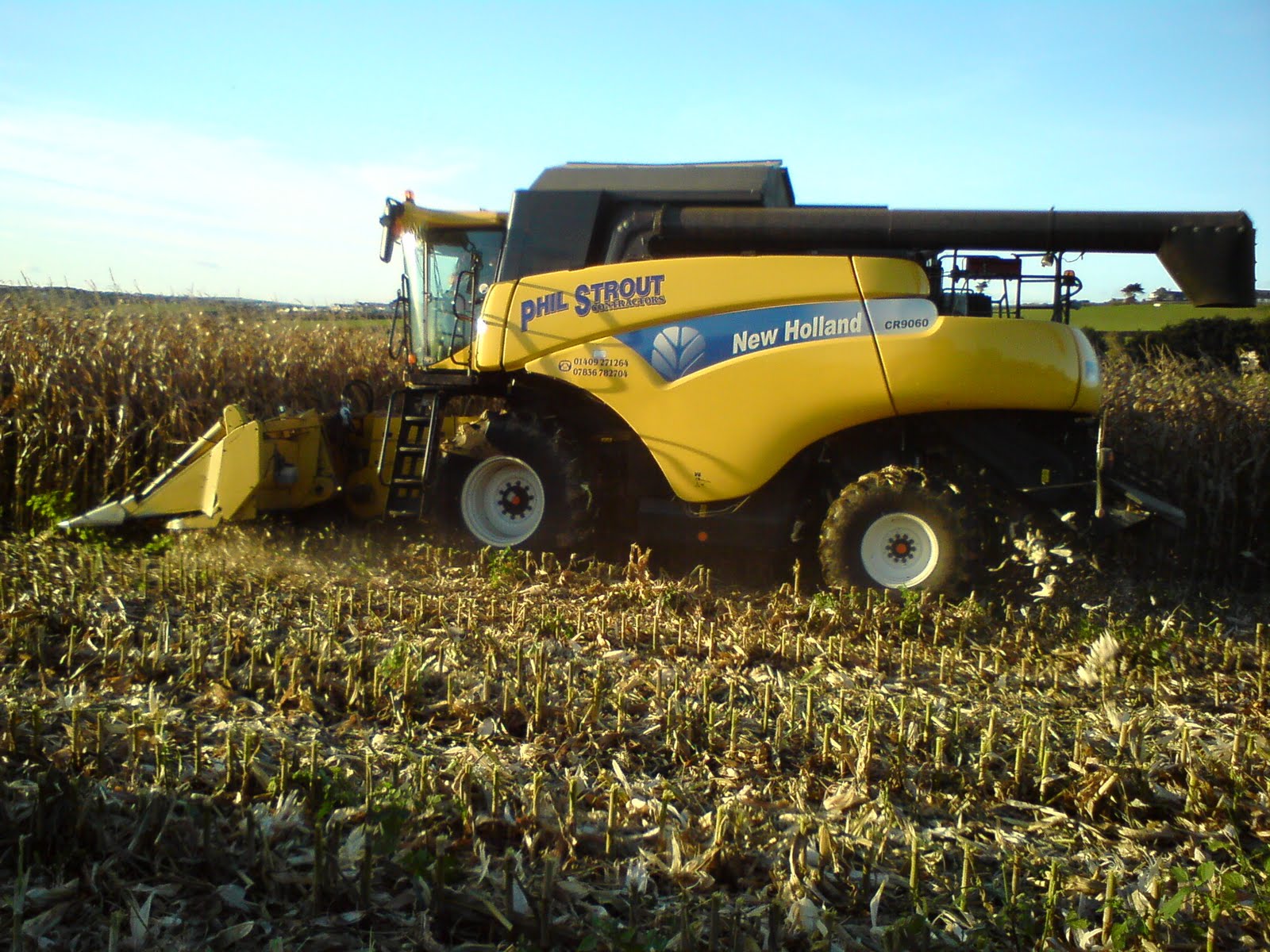
Combining Lorado at Bude

Never let it be said that Lorado is a short variety!


Lovely cornish autumn afternoon.

It's all happening!!!
Maize foraging is in progress, most of it is off, although a lot I think has been cut before it was fully fit, but the weather has been kind and the general feeling has been 'get it while you can'.


Lorado, the only early grain variety out there surprised us all by being ready as early as the 11th of October in some fields, the bulk being ready by the end of the week of the 16th, yields have been very promising, (even though the population was slightly higher than it should have been) at around an average of 5ton/ac at 32% moisture content. Very satisfactory.
Here are some pictures and video of the crop coming in.


Friday, 1 October 2010
World Food Situation.
http://www.telegraph.co.uk/finance/china-business/8019004/Global-food-risk-from-China-Russia-pincer.html
I know it's in the press at the moment, but this article poses some very interesting questions for british farmers, particularly livestock farmers feeding concentrates and bought in forages.
Having now had rain late so most farmers in the southwest have ample third cut silage, but little good quality first and second cuts left (there are exceptions of course), what do you do now going into winter with the burden of higher input costs in feed terms?
Do you feed for maintenance and low productivity in order to reduce imported feed costs by utilising what you've got on farm (praying that it will be enough to see you through till April in case we have another winter like last year), or do you de-stock to reduce the overall demand, or both, or do you take the risk of buying in expensive forage in the hope that end prices (and margins) will rise on the back of commodity price rises this autumn, with the associated cramping of cashflow?
Given the economic situation, will demand for meat and meat related products reduce if these prices rise substantially going forward? Reading between the lines of this article, it's looking like intervention to prevent price spikes may not be so forthcoming given what followed last time round in 2007/2008.
I know it's in the press at the moment, but this article poses some very interesting questions for british farmers, particularly livestock farmers feeding concentrates and bought in forages.
Having now had rain late so most farmers in the southwest have ample third cut silage, but little good quality first and second cuts left (there are exceptions of course), what do you do now going into winter with the burden of higher input costs in feed terms?
Do you feed for maintenance and low productivity in order to reduce imported feed costs by utilising what you've got on farm (praying that it will be enough to see you through till April in case we have another winter like last year), or do you de-stock to reduce the overall demand, or both, or do you take the risk of buying in expensive forage in the hope that end prices (and margins) will rise on the back of commodity price rises this autumn, with the associated cramping of cashflow?
Given the economic situation, will demand for meat and meat related products reduce if these prices rise substantially going forward? Reading between the lines of this article, it's looking like intervention to prevent price spikes may not be so forthcoming given what followed last time round in 2007/2008.
Subscribe to:
Posts (Atom)