Pages

Search This Blog

Tuesday, 17 May 2011

Yellow Rust!

Over the last 10 days I have come across a worryingly uncommon (for the very southwest) level of yellow rust in wheats and triticale, from way down by St Austell and Truro in Cornwall, to the Tamar Valley around Launceston, around Okehampton and now up around Holsworthy and Bradworthy in North Devon. It is also present in four varieties as of last week at the official Nickerson wheat trial site at Silverton, near Exeter. This last site, being closest to the midlands was not entirely surprising given the climate and locality.

Last week, four varieties were displaying symptoms. Another variety in a separate trial was also showing symptoms. Not entirely surprising given their rust ratings.

What I wasn't quite expecting to see was the level of infestation in my trial at Tregony way down in Cornwall. More worryingly was the level of disease in fields in the locality, some fields being yellow across the whole field. I have taken some samples to be analysed to see which strains are involved.

Leaf 2 of plants near Okehampton, disease just getting going.

More advanced infection near Tregony.

Another shot near Tregony.
The difference between a resust susceptable variety and a resistant one.
Classic focii of an outbreak of Yellow Rust. Near Launceston, Cornwall.

Major damage, this is Winter Triticale near Holsworthy. It only takes a short while to go from initial outbreak to this, that is why controlling the disease is so vital! What is more disturbing is the fact that most triticale varieties are being grown with supposedly good resistance to yellow rust, especially on organic farms. So to see this in a conventional farm is not good.

Tuesday, 10 May 2011

Maize under plastic 2011 trial.

A customer of mine  in Cornwall has finally decided to try out this maize-under-plastic method after being nagged and cajoled by his local contractor who has one of these special maize drills. This trial is for grain maize specifically, this system for forage maize is completely different and has some value in very unfavourable areas. Here are some photo's showing the results so far.

Drilled at the same time as the main crop which is Lorado, the earliest high yielding grain maize variety currently available. Please note the highlighted bit, I am not stating that it is the highest yielding variety, just that it's the earliest of the high yielders. This is an often overlooked factor when choosing grain maize varieties, outright yield is often the main selling point. I argue that it's no point growing this grain crop if you are expecting to harvest it in cold wet dark December, when the grain is more often than not contaminated by fusarium and other unpalatable moulds and diseases which spoil quality. Having a variety that will stand all the way through winter is hardly any advantage if the grain is rotten by then! Lorado is good in that it dries down very rapidly and is earliest to finish, when it's ready, don't hang around, go get it. If you wait, it will lodge just below the cob as previous post photo's show although grain loss is actually very small.

Lorado conventionally drilled next to Lorado under plastic. What is really interesting is that the Lorado is emerging better than the maize-under-plastic recommended varieties, as can be seen below.

Lorado emerging in these rows here very evenly and a lot more consistently.

Standard varieties in the first 10 lines, with Lorado on the outside 2 rows. Standard varieties really struggling to punch through the plastic compared to the Lorado.

One of the issues with this system of establishing maize in a dry year can be seen below. The rain has soaked in beautifully into the conventionally planted, but is bone dry under the plastic. The plants which haven't 'punched' through are under tremendous drought stress, are quite brittle in the stems and showing signs of damage. Bizarely the weeds under the plastic are flourishing as they have enough moisture to survive, even though this area has been sprayed with a pre-emergence herbicide. This can be seen in the photo's below.

Struggling to 'punch through' as it's claimed to.


Because the system of laying the plastic, spraying and drilling the seed is so task heavy and complicated, there is no way of banding a starter fertiliser into the seedbed. As a result, the plants have to scavenge for nutrients, something that maize does not do well. This I am sure is holding back growth and therefore inhibiting yield potential. The plants in the picture above this one if you look carefully are actually quite pale, compared to the plants planted conventionally, even though they are larger.

My main concern though looking at the picture above is weed control. Look at how big these weeds above are under the plastic, there is just no way of controlling these, you cannot over spray as the chemical will just land on the plastic sheet and maize just hates any weed competition. It's going to take a really impressive recovery from here to get me interested in spending an additional £160/ac over the conventionally grown grain maize.

Updates will follow, watch this space........

Tuesday, 26 April 2011

Weather worries!

Now I know a lot of media publications are printing stuff about how the climate is changing, that man made C02 is the cause of all the weird weather we have been experiencing lately.

I'm no climate change sceptic, having lived and farmed in the southern hemisphere and had to live with the vageries of El Nino and La Nina cycles, to my way of thinking what we are experiencing at the moment falls into this 5-7 year cycle. Last time we had dry weather was back in 2005, previous to that was 1995 that stands out. I remember that really bad drought we had in Zimbabwe back in the early 90's when it was so dry in the south that farmers were cutting thorn bush, then spraying it with a product called 'Brouse Plus', something that made the toxic tannins less toxic enough to stock  that they didn't die from eating it, but gave them enough sustenance to stay alive and not die of starvation.

Now I have been following the long range forecasts from Positive Weather Solutions on the right sidebar of my blog for a while now, they called the cold winter last year and the year before that, they also predicted the wet autumn and summer previously too. So when they issued a warning back in December that this was likely to be a dry spring I looked at what Bryce Anderson at DTN was saying too. Sure enough, he had picked up on the Southern Oscilation Index being at it's highest level for a very long time, greater even than that in 1976. I made a posting about this at the time, sceptically thinking it could go either way at the time. Well, speaking to farmers locally in Devon lately, the common thread is that this has been the driest start  they can remember, more so than 1976 where at least it was wet early so that 1st cut silage was a big one. This time, grass is wilting even before it's cut, with the effect that grass isn't really bulking up any more, hence farmers are flat out cutting and trying to harvest what is there before quality deteriorates further and praying that what nitrogen was applied has at least been utilised and is not going to end up in the clamps.

I know a lot of stock was turned out really early this year, not because the ground conditions were good, rather because there wasn't enough forage in the clamps to continue with full winter rations. I am now seeing stock that should have been out of fields, back in because they are running short on grazing elsewhere, with the knock on effect that 1st cut silage ground has been reduced. Farmers who are on summer grazing contracts and were hoping to have plenty of grass by 1st April after the sheep had been pulled out from winter keep are struggling to keep these grazing paddocks going due to the lack of grass growth from lack of rain.

It's interesting to see that those individuals who have been keeping half an eye on the weather conditions and have not held back on getting spring crops planted early are seeing the benefits of those decisions with these crops looking in good condition and with root systems able to manage the dry conditions. Those who have been following the calendar are now chasing ever diminshing levels of moisture in seedbeds that are drying out faster than normal with the current sunshine and cool dry easterly winds. I don't think I can recall hearing so many farmers  praying for rain in what we southern hemisphere types  would refer to as 'mud island'.


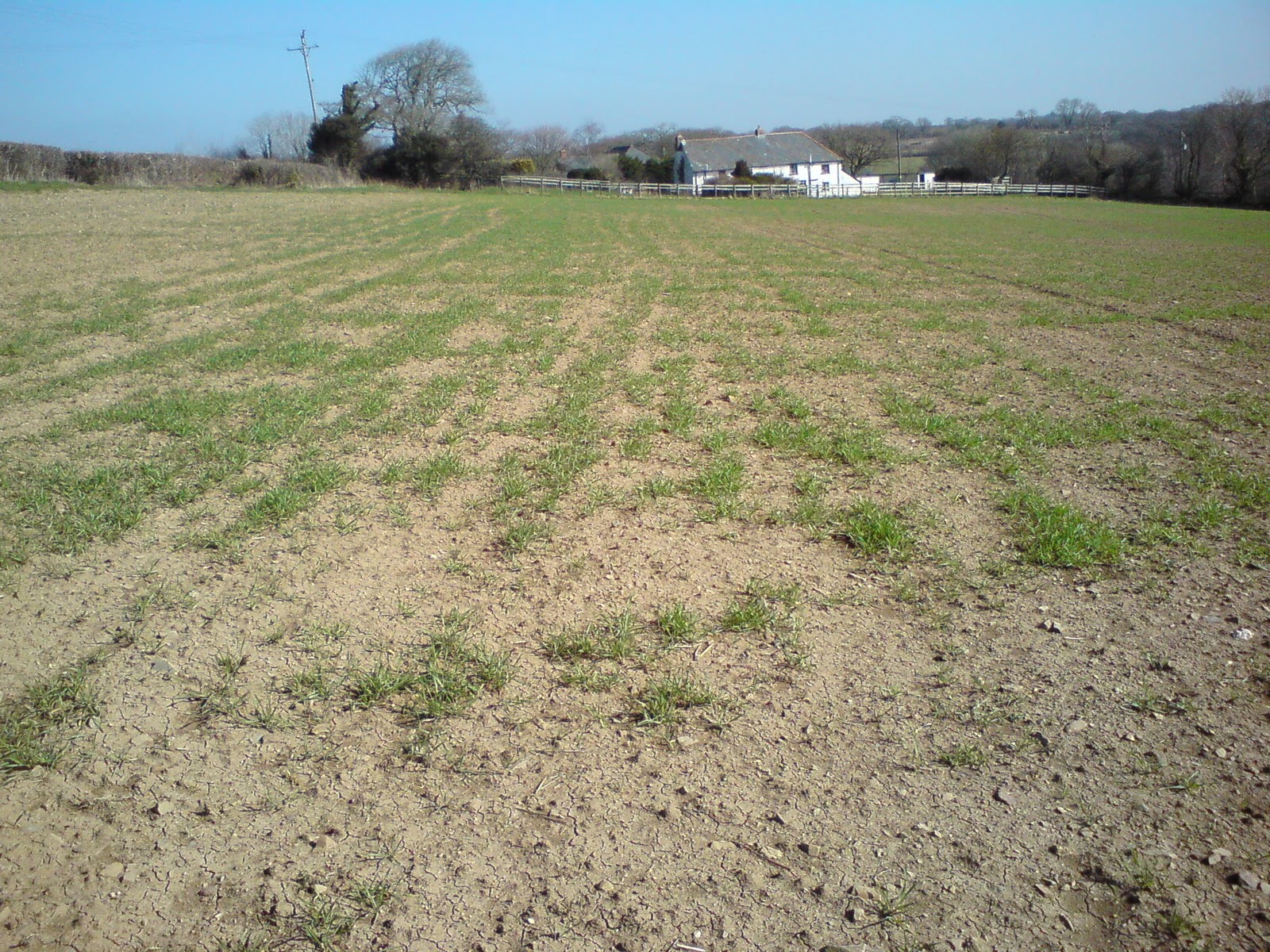
Very dry and dusty conditions at North Tawton on 26th April, drilling  maize trial. (hopefully it will rain enough to get going!)

The thing is, if you think UK has it bad, check the DTN report below, large parts of the southern US is looking at crop losses due to drought, whilst the northern states and Canada are way behind because it is too wet to cultivate. Then there crop losses in China and other parts that are going to play a part on total output this year. Hardly surprising then too see the wheat price for November 2012 rising to £158/ton. So forward selling, forward buying may be prudent, especially if you're a stock farmer wanting to fix some of your feed costs for next year, now.

So have a read of what Bryce is saying, makes for a sobering picture.
http://www.dtnprogressivefarmer.com/dtnag/weather

Thursday, 21 April 2011

Grass and the seeds of success.

Nickerson Circle leys have been around now for 57 years, as a brand they have always been surnonomous with market leading quality, durability and high yield, something that is not easy to achieve all three with. I find it immensley satisfying to meet farmers who have got Nickerson leys that are still highly productive, even though they are 20 years old, or in some cases nearer 30 years old. Obviously they were put together right!

As a seeds specialist, it is pleasing to see recently established pastures like these below starting to deliver the promises made, I have yet to come across a pasture that hasn't done what it's stated to do. In all the years that Nickerson Circle leys have been going, there has only ever been two indiviuals that have done the mixture formulations, Simon Broddle is the current man and has been doing it for the past 15 years or so having progressed from the research side of grass breeding and mixture formulations. He is involved with all the midlands dairy discussion groups, part of the leading benchmarking farms and has had a healthy hand in one farmer winning the Dairy Gold Cup not just once, but twice! I don't think there is any other seedhouse in the UK that can stake such a claim. It is therefore reassuring to know that everytime a customer sows a bag of Circle grass seed, there is a lot of science that has gone into producing it. The fact that the mixtures are trialled on farms with recorded daily milk yields on grazed grass where the differences in palatability, energy, regrowth etc can produce differences over 2 litres of milk/cow/day means that only the best tested mixes end up in the bags.

 Then there is the fact that Nickerson Circle leys are the only grass seeds that are treated with with Thiram and PGA (a P&K polymer seed film coating) both which combine to give a plant whose rootmass is double that of conventional grass seed at 6 weeks of age, the most critical stage in any grass ley establishment. This one of the reasons why these swards are so thick.

Silver Circle, a really high yielding mid-term ley suitable for cutting and grazing.

Silver Circle with a rich clover base.

Pro-Plus, a short term, very high quality grass mix with both red and white clover.

Pro-Plus overlooking the Tamar near Plymouth.

These photo's were taken on Monday this week, 18th April having been heavily grazed all winter by both beef and sheep, with the animals withdrawn at the end of February. Given the winter and start to the year we have had, this is pretty impressive regrowth! So anyone who is short of grass and looking for forage, this grass is for sale!

There is a link on the right sidebar of the page to the Circle Ley page showing the full range of mixes available.

Friday, 18 March 2011

Cornish Wheat Demonstration Plots 2011.

 
Xi 19: Cadenza x Rialto cross.
 Group 1 with potentially high yields even in the west country. Suited to later planting slot as vigourous grower. Good straw length, strength. Has a distinctive ear, moderately resistant to sprouting, can be sown late into February. Moderate disease profile as with some older varieties, been on the list for a long time before dropping off in 2011.


Except : Torch x Hereward
An old group 2 with exceptional septoria resistance, very stiff and short strawed with a very bold high specific weight grain. Suitable for organic production as well. Being outclassed now in terms of yield, an early drilling variety due to its slow growth habit in autumn. Seed stocks getting low which will hasten its unfortunate demise.

Einstein: Haven x Clarion cross.
World record holder for highest yield/ha. A group 2 with no major weaknesses, a good second wheat variety with good bold grain and specific weight, consistent across whole spectrum of soils and environments. Pretty much bomb proof.


 Panorama: Solstice x Xi19
A variety born out of great parentage, tall stiff strawed variety that holds great promise in this region, does very well as a 2nd wheat and on heavy land. A consistent high yielder with good specific weight, good disease resistance and resistance to sprouting. Did exceptionally well in 2010 when it was very dry, as being tall strawed, it had very good root development below ground and didn't suffer drought stress like other short varieties did at the Nickerson test site near Exeter.


                                                              Claire: Wasp x Flame
In it's 13th year on the recommended list, no other group 3 variety has been as consistent. Well liked for it's good disease profile, straw, standing power and multiple use applications from feed to milling, distilling and export. Likes the early drilling slot due to it's slow growth habit in the autumn, but can also being sown late up till end of February.


 Invicta: NSLWW48 x Robigus
New variety added to the RL in 2010, tall strawed, relatively stiff, Group 3 with a good disease profile. Has yielded 2% above Robigus. Will be interesting to see how it fairs here.


  Alchemy: Claire x (Consort x Woodstock)
Another variety of good parentage. Consistent, excellent disease resistance characteristics, produces good long stiff straw, with good specific weight. Suited for export, or feed, a slow grower in the autumn, but can be drilled late up till beginning of February.


Edmunds: Deben x Napier
A high yielding variety that didn't make the RL, similar yield and disease profile to Viscount, does very well on the east coast, outyields Alchemy by 3% , similar to Viscount. Short stiff strawed variety with good specific weight and grain suited to the animal feed market.


Istabraq: Consort x Claire
Long strawed, consistent high yielding variety that has dropped off the RL now this year. Produces big bold grains, with a god disease and particularly good Fusarium resistance making it ideal for the late sown after maize slot. Likes light land, has very good root stucture so can withstand drought stress well. 


 Cassius: Claire x (NSLWW24 x Wizard)
A very high yielding variety well suited to the north and east, short strawed, with very good yellow brown rust and mildew resistance. Does well as a 2nd wheat. Will be interesting to see how it does here.


 Gravitas: Alchemy x Robigus
Alchemy Mk2; 5% higher yielding than Alchemy, with a very similar robust disease profile, straw and growth habit, similar specific weight, as well as Orange Blossom Midge resistance. This variety should do really well in this area, so it will be interesting to see how it compares to the others.


Sahara: Savanah x Claire
This variety is being superceded by newer types, but it still has a very useful place on fams in the west. It has an excellent disease resistance profile, high specific weight, similar yield to Alchemy and does well as a 2nd wheat. Has a long stiff straw too.


 Stigg: (Biscay x LW96-2930) xTanker
A new and very interesting variety. There is no other variety on the RL that has a better disease profile! With an 8 for Septoria resiatance, 9's for rusts, 7 for eyespot and mildew, 6 for Fusarium, there is nothing else like it. Shortish,  stiff strawed and a distinctive ear, it is going to be interesting to see how this variety does. Has the highest untreated yield of any variety, so lends itself to organic production and low fungicide input regimes. Dairy Farmers wheat- put it in the ground and shut the gate till harvest type of plant. Only chink in armour is its slightly low specific weight, but from an animal feed / home roled and feed/ wholecrop point of view, not really an issue. Matched Alchemy last year in a low input scenario, so will see how it does here, at Sticklepath near Dartmoor (750ft) and Pelynt in South Cornwall.


 JB Diego: 3351b x Stru2374 (?)
High yielding hard feed wheat variety with tall stiff straw and mixed disease profile. Does well as a 2nd wheat and has good specific weight. Bred in Germany.


 Robigus: Z836 x 1366
Good 1st wheat, not 2nd! Mixed disease profile, now highly susceptable to Yellow Rust, moderate for sprouting resistance and being outclassed in yield terms too. Still has good Septoria resistance and still grown by quite a few farmers in Devon and Cornwall. Will be interesting to see how it fares this year.

 Deben:  (Hunter x Buster) x Wasp
An older variety, but useful nonetheless. Long strawed, a good disease profile, with good yield potential, also does well as a 2nd or continuos wheat. Does well on lighter, less fertile soils. This is the control variety with the rest of the field being drilled to Nickerson Original seed, so we should get a good yield comparison for all the varieties.


 Oakley: (Aardvark sib x Robigus) x Access.
Still the highest yielding variety on the RL, but downgraded due to poor yellow rust resistance. Agronomists favourite as you can sling as much chemical as you like at it and generally will give a yield response. Short strawed moderately stiff, moderately resistant to sprouting, preferably as a 1st wheat.


 Duxford: Solstice x Scorpion
A high yielding hard group 4 variety that does well as a 2nd wheat. Best suited to mid to late drilling slot, has a mediocre disease profile and is already showing signs of Septoria infection. Going to be interesting to see how it fares down here over the season.

Will keep an update of the plots and post accordingly, we will be having an open day where farmers from Devon and Cornwall will be very welcome to come and see for themselves how the varieties perform and question me and collegues on variety choices for 2011/12.


Tuesday, 8 March 2011

The cruel reality of a hard winter.


Bottom end of the same field.
Winter barley looking very sad, reality is that when you do the plant counts, the numbers just aren't there.
The best of the winter barley in this same field....
Click on the picture to see in full size, clearly shows exposed roots.
Another field of winter barley looking beyond recovery.
Einstein winter wheat, drilled in the normal timeslot, but this area of the field lies wet, normal year would have been OK.
If there were small roots, one could be forgiven for thinking too late drilled. However, there's plenty of roots here, most plants have really good root development, just not enough when you have this much frost heave in these heavy wet soils.
Contast this picture of late drilled Istabraq winter wheat with the Einstein above. This was drilled after maize in late October, but because it is slightly drier ground, not problems with frost lift.


And this is how you would expect the crop to be looking at this time of year. Panorama, fantastic group 2 winter wheat, wildly underated just like Istabraq. This was planted 1st week October 2010, drier ground near Bude.  Just shows the difference of 10 miles as regards factors affecting crop performance.

Monday, 7 February 2011

Weather outlook for 2011...????

Sometimes the past holds clues to the future, the weather patterns ebb and flow and generally do follow a cycle. Currently we are coming off the back of one of the coldest,harshest and driest winters for many a year. When I was farming in Zimbabwe, the El Nino/La Nina effect was fairly well known and we tried to plan accordingly where we were within the 5-7 year cycle. It is interesting note that warm wet southern hemisphere years correspond with hot dry northern hemisphere years during these cycles. So here are some stats from '75/'76 to jog the memory and for those that cannot remember, or weren't around then, bring you up to speed on what transpired.

1975/1976 (two-year drought):


1. The famous DROUGHT of 1975/76 was memorable for its severity over most of the British Isles, and also for its exceptional persistence. It produced the highest values for a drought index for south-east England in three hundred years. Not since 1749/50 had a period from one summer to the following spring been so dry in southern Britain. At Oxford, every month from May 1975 to August 1976 had below average rainfall with the sole exception of September 1975. It was the DRIEST 16-month period on record for England and Wales. The severity of the drought was highlighted by the acute hydrological impact of an exceptionally dry winter being sandwiched between two hot, dry summers. The drought was most severe in south-eastern England but was felt widely across England and Wales, and the most stringent water supply restrictions were experienced in South Wales, where water was cut off for up to 17 hours a day to domestic consumers. North-west England and much of western Scotland escaped the attentions of this notable drought and were more frequently subject to the passage of fronts associated with cyclonic systems displaced northwards by the high pressure over southern England.

1976 (January):

1. The GALE late on the 2nd (into the 3rd) in 1976 was one of the most severe to affect the British Isles in the twentieth century. Wittering (Cambridgeshire) in the east of England recorded a GUST of 91 knots at 2218 GMT on the 2nd and many stations across the NE of England, East Anglia and the Midlands experienced GUSTS in excess of 70 knots, with mean winds (hourly) 45 knots or more. Strong Gale or storm force was often reached with HURRICANE force 12 reported from some places in South Wales, southwest and northern England. Widespread damage and deaths (23 deaths noted at the time). A caravan site near Doncaster was destroyed. Some FLOODING on the North Sea coast: 4 feet (circa 1.2 m) of flood water in Mablethorpe and Sutton-on-Sea (Lincolnshire). DAMAGE was noted in almost every county of England, Wales & Northern Ireland. There were prolonged power cuts in widely separated areas. Railway services were badly affected in the Midlands because of the collapse of overhead power supplies. At Southend airport, a light aircraft was bodily lifted from the tarmac and thrown onto an adjacent railway line, where it burst into flames and blocked the railway services into London. [HS/23]

1976 (Spring):

1. Less than 50% of normal RAINFALL in the south-east of England during spring: contributing to the ensuing problems during the SUMMER DROUGHT.

1976 (June/July):

1. No previous HEAT WAVE in Britain, nor any since, has ever come close to the duration of the late June/early July 1976 HOT SPELL. From the 22nd June to 16th July, the temperature reached 80 degF daily. Even more remarkable, from 23rd June to 7th July, a period of 15 consecutive days, the temperature exceeded 32 degC somewhere or other in the country.

1976 (May75 - Apr76):

1. For England and Wales, the 12 month period May 1975 to April 1976 was the DRIEST 12 month period since the series began (?EWR) in 1727.

1976 (Summer):

1. It was easily the DRIEST, SUNNIEST and WARMEST summer (June/July/August) in the 20th century (at this date, but see 1995 - which is now regarded as the driest). Only a few places registered more than half their average summer rainfall. In the CET record, it was the WARMEST summer in that series.

2. It was the WARMEST summer in the Aberdeen area since at least 1864.

3. It was the DRIEST summer since 1868 in Glasgow.

4. Probably the HOTTEST summer for over three centuries. CET values were (with anomalies rel. to 1961-90 averages): Jun:17.0(+2.8), Jul:18.7(+2.6), Aug: 17.6(+1.8). In particular, for the period mid-June to mid-July, 1976, this was one (of two, the other being in 1826), WARMEST 30-day periods in the CET series, with a value of 19.7degC.

1976 (September+October):

1. For England and Wales as a whole (EWR), it was the WETTEST such spell in the entire record ... back to 1727. The combined EWP value for September & October=305mm. (Since 1727, the rainfall of September 1976 is 10th wettest in the series.) [ The wettest September + October totals since 1727 were during 1903 (310mm), 1841 (295mm) and 1960 (290mm), therefore the total for 1976 (September+ October) at 305mm is close to a record. ]

1976 (Autumn):

1. A notably VERY WET autumn for all areas ( except for north and west Scotland.) In some parts of northern England, and the extreme south, 200% of average rainfall was recorded. [ Coming after the notably dry spring/summer of course ] Information taken from here: http://alturl.com/x7kf9

Now let's look at the current situation, courtesy of Bryce Anderson from DTN/The Progressive Farmer website, the link to which is on the right hand side bar of my page.

The development of that northern high pressure block is still to be determined; however, La Nina is definitely around and, in fact has reached some historic levels. The Australia Bureau of Meteorology announced recently that its records of the Southern Oscillation Index (SOI)--the barometric pressure component of El Nino/La Nina which tracks the comparison between Tahiti and Darwin--had an average value of +21.1 between August and December 2010. That average is the second-highest Aug-Dec value on record--second only to the La Nina of 1917-18, which had a value of +24.4. But--more to the point in terms of crop concerns--the current La Nina moved past the La Nina of 1975-76, which had a reading from August through December of +18.8.


Now, here's where it gets interesting if you're looking for comparisons. I checked with our contributing analyst Joel Karlin of Western Milling for some corn yields for 1976--and found out--as I thought--that '76 was a real have and have-not year in the Corn Belt.
Here are the numbers. The U.S. national yield declined by 4.2 percent. And in some selected states, Joel sent these yield figures: Eastern Corn Belt states were above trendline for the year, with Illinois +2.1 pct; Indiana +10.4 pct; Ohio +7.6 pct; and Kentucky +23.3 pct.


But, the Western Corn Belt had a much different story: Iowa's yield was down by 11.4 pct; Nebraska down 10.6 pct; and Missouri down 22.3 pct. I don't have yield information for other states west of the Mississippi, but after talking with producers in Sioux Falls about the 1976 season I have no doubt that such declines in yield were similar or even greater.


Now, 1976 was an entire generation ago, and corn production is far, far more advanced. This account is also a look at just one of many parts in the production scenario. Still--the strength of this La Nina bolsters ideas that its influence will be around through at least the first half of the 2011 season--and we will not discount its presence as we approach the end of winter.

So where does that leave us here in the south west? Well, I am not counting my chickens, however my advice is get all land prep done earlier, consolidate moisture in seedbeds and plant early, don't wait for a calender date. Don't ladel nitrogen on, as this will encourage rank vegetative growth which will exaccerbate moisture stress, conserve every blade of grass you can if a livestock farmer and hope like hell we have rain at critical growth stages to see crops through.

Positive Weather Solutions are currently saying it will be a drier, earlier spring too so lets pray that September and October don't produce swamp conditions and make establishing next years(2012) crop hard work. Here is their current outlook. Take note, given they got last year pretty much right, as well as forecast a very cold winter last year and the year before..... http://alturl.com/cwmce