Pages

Search This Blog

Tuesday, 20 September 2011

Maize 2011 so far.

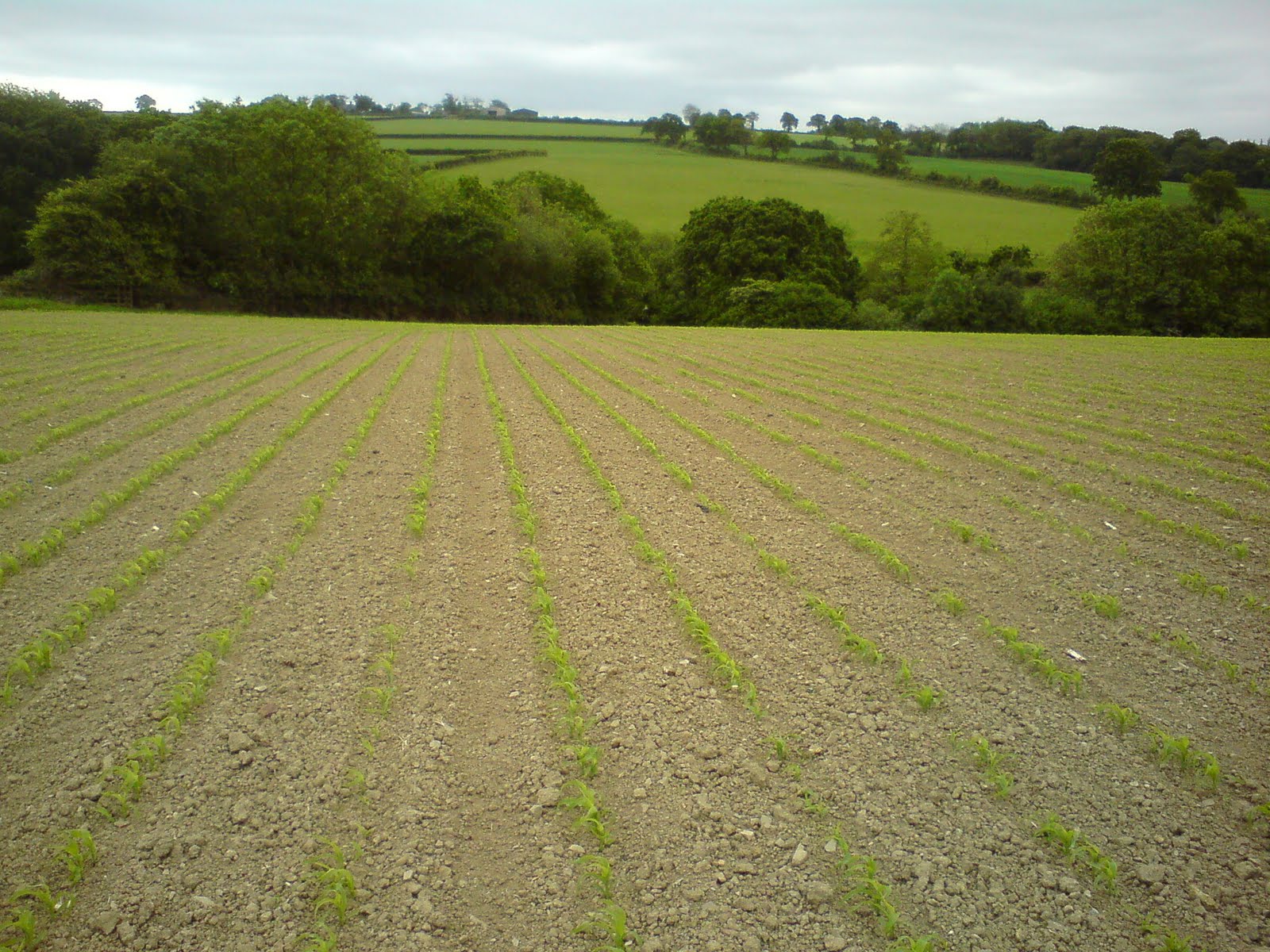
It all started so well, warm hot weather, ideal sowing conditions and this on the 10th April through to 19th.
Dust flying as the demo plots are drilled at North Tawton.

Maize under plastic really started to struggle in the dry weather. The conventionally drilled stuff actually looked really good in comparison, wasn't as badly droughted.

In the early stages, condensation on the underside of the sheets was enough to keep the plants going, but the weed problems were only just beginning as can be seen in the photo. This system really does need very robust chemical input, which only adds a very significant cost loading, £70+/ha, to the spray program and even then expect to do a post emergent spray program as well. Looking at the sums supplied by the Maize Growers Association, the cost per ton of DM is still higher, even with an additional 25% yield advantage over conventional.

Lorado drilled conventionally, with Lorado and standard varieties in a small trial to see the differences. Under plastic stuff noticeably paler as not starter fertiliser available early on to get plants going.

Some seed was drilled  really deep! It was also rolled afterwards and I was worried it would really battle to come through. Fortunately it worked and the crop looks pretty good.

Germination generally was good., but on heavier ground it was patchy. Near Ashwater.

Beethoven standing like soldiers, near Launceston

The prolonged wet spell in June (just after the declaration of a drought) along with cool damp windy conditions started to encourage eyespot formation and spread on 2nd year maize ground. This taken on 24th June, way earlier than thought normal caught a lot of people off guard with a lot of people advising not to spray as it was too early...?

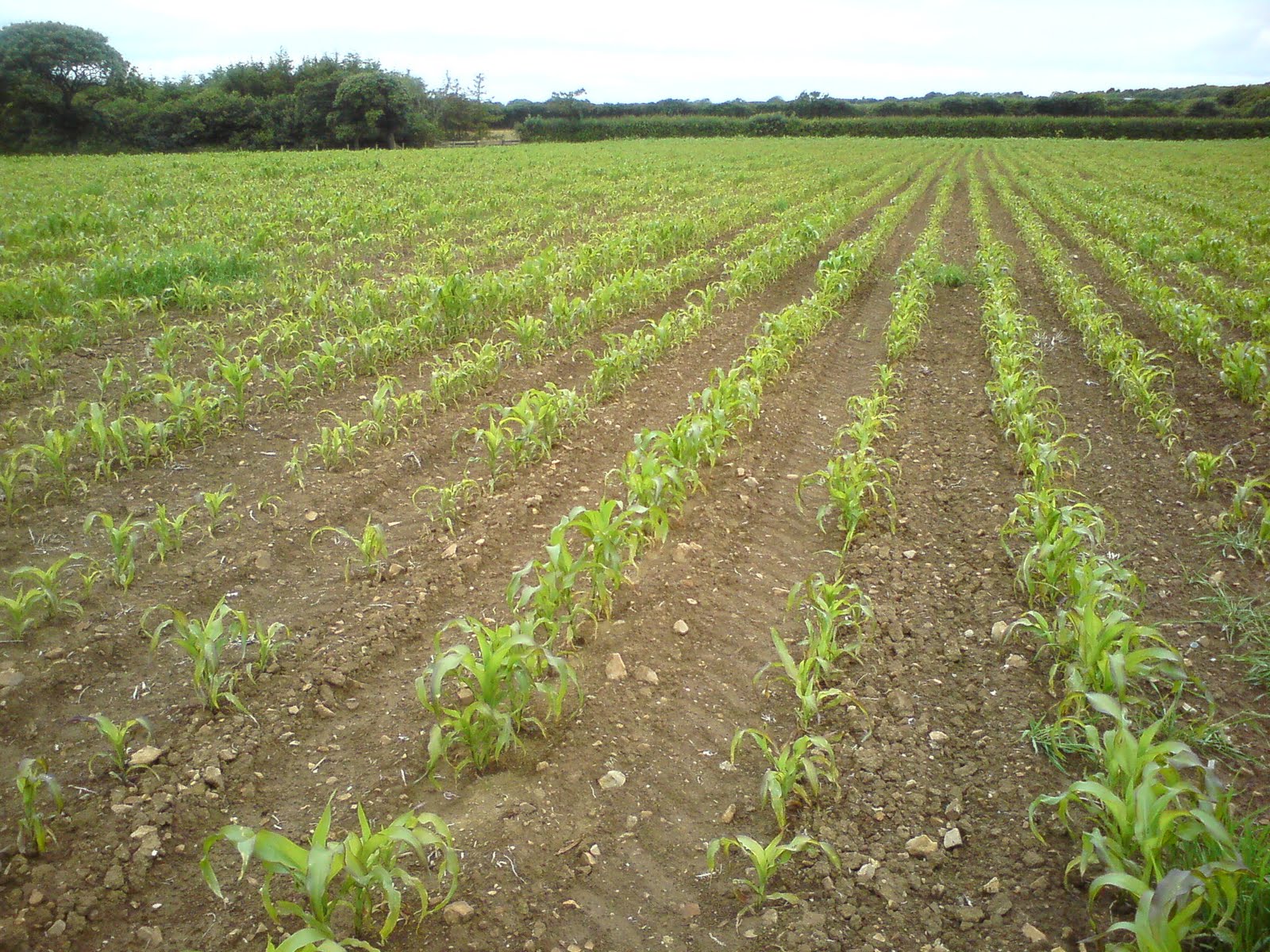
Later drilled maize really struggled to germinate due to the dry conditions, then struggled with the cold dry windy conditions which was then further exaccerbated by the cool wet windy conditions in June and July. Not good!

On south facing, warm, more sheltered fields the maize kept on growing, albeit slowly.
The dry, cool, conditions early on meant weeds didn't germinate, or came up sporadically meaning spray timings were tricky. On top of this, the very windy conditions made this even more difficult with windows extremely tight, a lot of the time being missed resulting in situations like the above.  These conditions lead to applications being apllied later than ideal with resulting leaf scorch, stunting etc.

Leaf scorch after late spraying.

Desperate situation.

Eyespot continued to spread whilst spray advisors held off spraying.....

15th July and not looking very good, the cool dry conditions meant soil temps were low, root growth and nutrient uptake poor, foliar feed sprays with P&K, Zn, Mo, Cu, Mn and S definitelly helped rescue the situation.

Plant development by 15th July in the poorest fields near Holsworthy. This crop was drilled 20th April, in a field that was 5th year in maize, quite exposed to south westerly wind, but not the worst maize ground by any means. Shows what cool, dry windy conditions do to maize.

3 weeks after initial eyespot discovery and the leaf areas effected were drastically worse. This stimulated action on the spraying front, albeit late!

Eyespot effected plant.

20th July and Eyepot is serious where not sprayed early.

New variety Ambition, alongside Beethoven. The way the leaves grow more erect in Ambition makes it look more impressive, however the tops of the funnels are roughly the same height. Ambition is a slightly earlier maturing variety that has promise, supposedly yielding as well as Beethoven which is the highest yielding variety in marginal areas.

Eyespot getting up onto the top leaves now, 20th July.

Fieldscale photo showing how it spreads from focii.

The effect of wind on growth, plants at least 6 inches taller where protected by sheltered area of the hedge.

Not the tallest maize plant, but eyespot on all leaves. Early treatment, not planting more than 2 crops on the trot, and warm dry weather all help in preventing Eyespot.

Lorado cob taken from field at Bude. Lorado (for grain) was planted 15th April. The other cob is from a crop near Holsworthy, planted 10th of May, don't know what variety it is, but as at 20th September this cob has no real grain development at all.  As that process normally takes 10 weeks in average conditions from August through to early October, the chances of any starch being laid down are very poor, given we are now in cooler temperatures and shortening daylight hours and potential night frosts. All in all, the situation for the white cob maize is pretty dire. This raises some very important questions about what to do now. The grower has a very large dairy herd, the ground is prone to getting wet and sticky fairly quickly, it's in a catchment sensitve area not far from major water courses. Does he wait till November in hope that he gets some starch development and run the risk of causing potentially severe soil run-off into the water courses, or take it earlier whilest ground conditions are better with little starch and green and try and chop it and preserve it in the clamp as best he can? Hobsons choice?

More photo's will follow, but what is really clear this year is that those who planted when the conditions were right, not by calendar  date have the better crops as they were able to get away early, get roots developed so that when the conditions became adverse, the plants were better able to cope.

Today, 20th September, the weather has been wet, mizzly and generally more like a November day than normal, the ground is wet, soaked right through, travelling conditions are poor and it is going to require a good period of dry weather to enable maize plants to dry down and reach maturity. My fear is that having seen such variability in fields from uneven germination, judging the right time to harvest is going to be judged more by traveling conditions and a desire to get the crop in the pit, than when the crop is fit to cut. Another factor at this minute in time is the weather, it really is favouring eyespot development and spreading, if it continues in the same vein for a week like it was today, the plants are going to be dead from the disease in 2 weeks anyway, with the result that starch levels won't increase much as the plants won't be photosynthesising. Waiting till November for the plants to die off and thereby try and raise the drymatter is not really going to help either, the cobs won't mature anyway if there is no green leaf area. The only thing to do will be to cut it and make provisions for possibly acidic silage and additional effluent, which can be mitigated by using chopped straw, or better still, chopped sugarbeet on the floor of the pit to soak it up. The other risk from leaving plants badly effected  by eyespot in the field for a protracted period in the hope of raising drymatter levels is the increased rick of afflotoxins developing, Fusarium in particular, which will effect cows ferility and general well being far more than feeding a bit of acid silage. At least the acidity can be buffered, afflotoxins will do far more and longer term damage to cow health and milk yield than acidity, so trying to harvest brown paper like maize is NOT a good idea. 30% drymatter and 30% starch is going to be good down here this year, 25%  I think is going to be more likely the norm this year.

Another very important consideration from now on for anyone farming in a catchment sensitive area is that the Environment Agency are going to be utilising existing legislation to prosecute and enforce best management practice with relation to run-off, soil sedimentation/siltation from fields that polute/ silt up watercourses. The legislation is already there, be warned, they will not be as tolerant with people who grossly flout the rules. As the main man from the EA said at the MGA meeting, it's like speeding, doing 80mph on the motorway, you'll probably get a caution, doing 60mph in a 30mph zoine past a school, they will through the book at you and it will go strait to court! Dragging very muddy vehicles/trailers out onto roads/tracks right next to watercourses, not chisseling the maize stubbles right behind the harvester to reduce surface run-off and soil erosion if they are to be overwintered are going to be hotly monitored in the South West and other catchment sensitive areas. The EA will be monitoring from the air too, they have the aircraft standing by, they will be able to pinpoint exactly where the problems arise,photograph it and present the evidence, so it is in everyones best interest if the principles set out on the MGA site, in the DEFRA Soil Management Guide, as well as other sources are adhered to.

Wednesday, 17 August 2011

Joining the Apple revolution.

I always thought that Apple was a brand that was favoured by hippies, refusniks and other peripheral types when I was growing up and at college. Macs were frowned upon by the academic fraternity when I was at Ag college, first time round we used dos and other antequated software which was hard to grasp and put me off computers nearly for life.

When I did my MBA in 2001, windows was all the rage and again Macs were kind of frowned on and most people took the mickey of anyone who even thought about using one, let alone owned one! Part of my business strategy classes was looking at Apple Inc and the role mavericks and key individuals can have on a business. Steve Jobs has been key to the success of Apple, from being a small struggling business making niche Market computers, it is now recognised as probably the biggest global super brand.

Having been a dedicated windows man up until Monday, mocking my sister and mother about their 'indoctrination' into being Mac users, my patience with my windows running laptop finally snapped. Plagued with continuos error messages, Internet explorer suddenly shutting down for no apparent reason, the machine hanging and freezing mid way through writing something on here, I almost lost my rag and hurled it against the wall. Now I have a colleague who has been showing off his iPad, doing stuff with it which was quite amazing, mocking us other guys about how backward we were using windows etc. He gave some ofus a demo of just how fast his iPad(16gb version 1) was compared to our 2ghz laptops. It was taking him seconds to do things, us minutes to do the same things.......

So Monday afternoon I had a seminal moment, went down to the local Apple store in Exeter and saw one, the iPad mk2. Now I can see why people say it's a cult, guys in blue Apple t-shirts, immaculate, clean, simple store layout, incredibly customer focused, it just shouts out for you to go in and play with the stuff. Sweetshop mentality, it is almost impossible to resist. I have often been past this store, usually it is packed, barely room to see anything, let alone try it out, so I went in late, just 20 minutes before closing, only a few people there to see what it was all about, why were these fan dangled machines so popular. I had been looking since spring at the new smartphones, sussing out what they could do, etc. I like the Samsung Galaxy S2, it's big screen etc. I had SO nearly signed up for one, but then I saw out of the corner of my eye the recommended antivirus, my heart sank having already suffered 2 viruses this year through attachments on twitter. This young guy asked if I needed help and then swiftly, simply and completely blew me away with what the iPad2 could do. And FAST! It is hard to resist fact, deny it when you see it, everything I experienced was exceptional in customer satisfaction, so 20 mins later I walked out of there with an IPad2 and the biggest grin I have had for a while.

There are so many underlying metaphors in this blog about life, work, companies and quality. If other companies had similar corporate strategy, ethos, focus, service and focus on customer satisfaction, maybe shopping would be a happier experience. The striking thing about Apple is this, it's NOT CHEAP, you will bleed financially, wince as you suddenly find that all the goodies that go with it will make you bleed even more, not to mention all the apps out there and they don't do check-outs with tills etc, it's so fast and simple you don't have to time to blink! But as a customer said to me earlier this afternoon, if the quality of the product is so good, price is not the issue. He bought Red Circle grass seed.

So thanks for reading my first blog written from my iPad, I am still grinning from ear to ear.

Saturday, 16 July 2011

Wheat......Update on Demo plots.

The Cereals Event has been and gone, lots of flashy paint, plant and toys to entice anyone to part with a serious load of wedge/notes (depending from which side you come from). Lots of fancy stuff in the agchem arena and equally large and expensive machinery to apply it with. It seems every year the prices of these tools become ever more stratopheric, if inflation is supposed to be in the very low single digits, then you need a stiff drink and a new set of glasses to fathom the price increases in four wheeled machinery!

There has been a lot of comment in the farming press lately about wheat variety selections for the 2012 season, with emphasis as always being placed on the new upcoming varieties that have made the recommended list(RL). I personally have some misgivings about the way the list is put together, because I think that it doesn't always reflect what is actually happening with varieties in different regions, indeed soil types, even though there are North, South, East and West specifics. How does a wheat perform say on heavy wet land in Devon (when the land the RL trials are conducted on is light free draining reds near Exeter).  Likewise, ground in Dorset differs markedly from that in Kent, yet both count as South.

The RL trials are littered with the corpses of varieties that supposedly never made it onto the list because they failed, or were inconsistent over a multitude of sites. A classic example of this is a Nickerson bred variety called Lear, a variety way ahead in yield when it came out, Orange Blossom Midge resistance, superior septoria and rust resistance, fantastic grain quality and a good amount of straw, everything you could want in a western wheat. It didn't make the list because apparently it had weak straw. Well, tell that to the farmers who are growing it and getting exceptional yields from it! I remember Bill our wheat breeder reflecting that he should have fought harder to get it approved as it was a very good variety, however because of the process, not all candidates make it, so they were sanguine about it at the time, but regret it now. Commercial seed stocks are very limited as very few grow it. Likewise Deben now, supposedly outclassed by the newer varieties on the RL. Last but not least, Istabraq, dropped from the RL trials program now, considered an 'old' variety, but in last years trials at Exeter was joint top yielder at 118% with the highest specific weight. Go to Scotland, like I just have this week and you will see Istabraq outperforming the newer wheats hands down in the field, still the best distilling variety out there. Then there's Alchemy, still at 112% at Exeter last year, 4th highest yielder ahead of a lot of newer RL stuff, but supposedly outclassed by these same varieties on the printed RL books. To me, consistency of yield is more important than one years performance and knowing the genetic parentage of a variety is a vital clue to this consistency.

So this begs the question, why are we seeing a 3% yield increase roughly year on year in the RL system, but this is not being translated to farm level. Last year, someone I know in Wiltshire averaged 11.2t/ha (sold!)over 350Ha growing Solstice, Claire and Duxford(2nd wheat slot). You don't have to be a mathematician to appreciate the profitability of growing high yielding milling and feed wheats when wheat is trading at nearly £200/ton. Claire is 12 years plus old, yet it is still more than capable of producing good yields, even in difficult places like North Devon, so why are there people out there slating it and saying it's getting old and falling behind newer varieties? Is the process of selection producing varieties of high potential yield, but with poor to mediocre specific weights and hagbergs, which will sprout if you sneeze on them at harvest time? Are breeders, as a result of the RL system, being tempted to make quality sacrifices in genetic resistance to disease by releasing varieties with only single gene, rather than polygenic resistance factors, which then break down only a year or two after being released, or even whilst still in the trials stages? Is the drive by big chemical companies that are buying up small to medium scale cereal breeding companies limiting diversity of research? My fear is that this 'race' to release new varieties is leading us down a blind alley, where more and more genetic material is 'burnt' as varieties break down to rusts etc and resistant genes become fewer and fewer to the point that genetic modification becomes the only road available to maintain wheat production.

Is the new chemistry that is being applied to varieties negating yield performance in the field, are some of these tank mixes that are being put together actually depressing the plants abilities through phytotoxicity? How many farmers/agronomists are actually applying recommended rates and mixes as stipulated by manufacturers? Did you know that Nickerson tests a full range of different fungicide programs from different maufacturers over the course of a candidate variety going through the NL and RL processes, which once approved is freely available so growers can see which spray program produces the best result for that specific variety. I asked a very successful farmer this the other evening at one of my demonstration events, to which he replied no, never knew it, never seen them, his agronomist had never given him one. http://www.nickersondirect.co.uk/products/winter_wheat1.html  Check for yourself, the info is here and if it's not, then I sure can find it.

So, after all that, have a look at what these wheat varieties down near Tregony in Cornwall look like, some good, some not so good, lots to learn and observe, this has really been a 'shake-out' year for many wheat varieties and we aren't done yet! Have a look at the wheat near the end of the plots next to Duxford, This is Nickerson Original Deben treated with GPA. Looks better than a lot of the material in the plots, it will be very interesting to compare its yield to the ordinary Deben in the plots and the other varieties. Then there's Stigg, maybe not everyones cup of tea, but it does point the way we need to be looking for septoria resistance!

Tuesday, 24 May 2011

Grassland and Muck 2011

This is the first time I have been on the stand at this event and what an event it was, those of you who missed it really did miss a very good show, even if the weather on the first day was fickle.

Nickerson has been doing this show for a long time and as usual it didn't disappoint as Simon Broddle had spent a lot of time and energy making sure it had plenty for people to look at and discuss. No point in showing things in photo's if you can root around and actually see the practical benefits 'hands on' so to speak.

The one display that got most people talking and thinking was the 'Broadcast vs Drilled' circle. The mix was Blue Circle, a 10 year ley with a good spread of early, intermediates, and late perrenial ryegrasses and a mix of small, medium and large leafed white clovers. The plot was broadcast and drilled (half : half) at the standard 14kgs/ac rate, the drilled piece being drilled with an amenity drill on 2" row spacings. A conventional cereal type drill would have much wider rows and would have accentuated the problems even further.

Visually, the broadcast part looked shorter and there were far fewer heading plants, whilst the drilled part looked more impressive with taller heading varieties. However when you got up close and looked into both swards, the drilled part was much thinner, there was more weed species visible which were growing in the gaps between the drilled rows, the species of grass in these rows were virtually all tetraploid and hybrid species of ryegrass, the clovers were mostly long petiole large leafed, with little of the smaller white clovers surviving. Basically, the drilled lines had squeezed out all the diploid types, along with the medium and small clovers, completely altering the nature of the sward from a longterm ley to a medium term one more suited to cutting than grazing with sheep and cattle. The same thing happens when you plant grass seeds too deep! The broadcast part on the otherhand was thick, like a carpet, had all the species in the mix present and had produced 400kg/ha DryMatter (DM) more than the drilled part. Over a season this would equate to nearly a tonne of DM more for the broadcast part than the drilled portion. This difference is worth the cost of the seed, in the first year alone! Makes you think.....

Click on the pictures to see it in full size, they're not the clearest one I know, but it shows what I have been talking about above.


The upshot of this stand display was one farmer cancelling his newly ordered grass drill which he confessed to buying earlier in the day as 'all the farmers and contractors around us are using these drills now and we thought they looked like there were doing a good job'. Having looked at this demonstration agast at the differences and losses, he cancelled the drill order......

The broadcast piece on the left, drilled to the right of the posts.

The show although suffering with a lack of grass through the drought, was very busy for us, the general consensus from people being it was well worth the effort to get to it. It was amusing to hear that even though there wasn't a lot of grass, they still managed to block the Krone BigX forager, the clip of which can be found here: http://www.youtube.com/watch?v=Bb2FSgt1zOA&feature=feedu

Tuesday, 17 May 2011

Yellow Rust!

Over the last 10 days I have come across a worryingly uncommon (for the very southwest) level of yellow rust in wheats and triticale, from way down by St Austell and Truro in Cornwall, to the Tamar Valley around Launceston, around Okehampton and now up around Holsworthy and Bradworthy in North Devon. It is also present in four varieties as of last week at the official Nickerson wheat trial site at Silverton, near Exeter. This last site, being closest to the midlands was not entirely surprising given the climate and locality.

Last week, four varieties were displaying symptoms. Another variety in a separate trial was also showing symptoms. Not entirely surprising given their rust ratings.

What I wasn't quite expecting to see was the level of infestation in my trial at Tregony way down in Cornwall. More worryingly was the level of disease in fields in the locality, some fields being yellow across the whole field. I have taken some samples to be analysed to see which strains are involved.

Leaf 2 of plants near Okehampton, disease just getting going.

More advanced infection near Tregony.

Another shot near Tregony.
The difference between a resust susceptable variety and a resistant one.
Classic focii of an outbreak of Yellow Rust. Near Launceston, Cornwall.

Major damage, this is Winter Triticale near Holsworthy. It only takes a short while to go from initial outbreak to this, that is why controlling the disease is so vital! What is more disturbing is the fact that most triticale varieties are being grown with supposedly good resistance to yellow rust, especially on organic farms. So to see this in a conventional farm is not good.

Tuesday, 10 May 2011

Maize under plastic 2011 trial.

A customer of mine  in Cornwall has finally decided to try out this maize-under-plastic method after being nagged and cajoled by his local contractor who has one of these special maize drills. This trial is for grain maize specifically, this system for forage maize is completely different and has some value in very unfavourable areas. Here are some photo's showing the results so far.

Drilled at the same time as the main crop which is Lorado, the earliest high yielding grain maize variety currently available. Please note the highlighted bit, I am not stating that it is the highest yielding variety, just that it's the earliest of the high yielders. This is an often overlooked factor when choosing grain maize varieties, outright yield is often the main selling point. I argue that it's no point growing this grain crop if you are expecting to harvest it in cold wet dark December, when the grain is more often than not contaminated by fusarium and other unpalatable moulds and diseases which spoil quality. Having a variety that will stand all the way through winter is hardly any advantage if the grain is rotten by then! Lorado is good in that it dries down very rapidly and is earliest to finish, when it's ready, don't hang around, go get it. If you wait, it will lodge just below the cob as previous post photo's show although grain loss is actually very small.

Lorado conventionally drilled next to Lorado under plastic. What is really interesting is that the Lorado is emerging better than the maize-under-plastic recommended varieties, as can be seen below.

Lorado emerging in these rows here very evenly and a lot more consistently.

Standard varieties in the first 10 lines, with Lorado on the outside 2 rows. Standard varieties really struggling to punch through the plastic compared to the Lorado.

One of the issues with this system of establishing maize in a dry year can be seen below. The rain has soaked in beautifully into the conventionally planted, but is bone dry under the plastic. The plants which haven't 'punched' through are under tremendous drought stress, are quite brittle in the stems and showing signs of damage. Bizarely the weeds under the plastic are flourishing as they have enough moisture to survive, even though this area has been sprayed with a pre-emergence herbicide. This can be seen in the photo's below.

Struggling to 'punch through' as it's claimed to.


Because the system of laying the plastic, spraying and drilling the seed is so task heavy and complicated, there is no way of banding a starter fertiliser into the seedbed. As a result, the plants have to scavenge for nutrients, something that maize does not do well. This I am sure is holding back growth and therefore inhibiting yield potential. The plants in the picture above this one if you look carefully are actually quite pale, compared to the plants planted conventionally, even though they are larger.

My main concern though looking at the picture above is weed control. Look at how big these weeds above are under the plastic, there is just no way of controlling these, you cannot over spray as the chemical will just land on the plastic sheet and maize just hates any weed competition. It's going to take a really impressive recovery from here to get me interested in spending an additional £160/ac over the conventionally grown grain maize.

Updates will follow, watch this space........

Tuesday, 26 April 2011

Weather worries!

Now I know a lot of media publications are printing stuff about how the climate is changing, that man made C02 is the cause of all the weird weather we have been experiencing lately.

I'm no climate change sceptic, having lived and farmed in the southern hemisphere and had to live with the vageries of El Nino and La Nina cycles, to my way of thinking what we are experiencing at the moment falls into this 5-7 year cycle. Last time we had dry weather was back in 2005, previous to that was 1995 that stands out. I remember that really bad drought we had in Zimbabwe back in the early 90's when it was so dry in the south that farmers were cutting thorn bush, then spraying it with a product called 'Brouse Plus', something that made the toxic tannins less toxic enough to stock  that they didn't die from eating it, but gave them enough sustenance to stay alive and not die of starvation.

Now I have been following the long range forecasts from Positive Weather Solutions on the right sidebar of my blog for a while now, they called the cold winter last year and the year before that, they also predicted the wet autumn and summer previously too. So when they issued a warning back in December that this was likely to be a dry spring I looked at what Bryce Anderson at DTN was saying too. Sure enough, he had picked up on the Southern Oscilation Index being at it's highest level for a very long time, greater even than that in 1976. I made a posting about this at the time, sceptically thinking it could go either way at the time. Well, speaking to farmers locally in Devon lately, the common thread is that this has been the driest start  they can remember, more so than 1976 where at least it was wet early so that 1st cut silage was a big one. This time, grass is wilting even before it's cut, with the effect that grass isn't really bulking up any more, hence farmers are flat out cutting and trying to harvest what is there before quality deteriorates further and praying that what nitrogen was applied has at least been utilised and is not going to end up in the clamps.

I know a lot of stock was turned out really early this year, not because the ground conditions were good, rather because there wasn't enough forage in the clamps to continue with full winter rations. I am now seeing stock that should have been out of fields, back in because they are running short on grazing elsewhere, with the knock on effect that 1st cut silage ground has been reduced. Farmers who are on summer grazing contracts and were hoping to have plenty of grass by 1st April after the sheep had been pulled out from winter keep are struggling to keep these grazing paddocks going due to the lack of grass growth from lack of rain.

It's interesting to see that those individuals who have been keeping half an eye on the weather conditions and have not held back on getting spring crops planted early are seeing the benefits of those decisions with these crops looking in good condition and with root systems able to manage the dry conditions. Those who have been following the calendar are now chasing ever diminshing levels of moisture in seedbeds that are drying out faster than normal with the current sunshine and cool dry easterly winds. I don't think I can recall hearing so many farmers  praying for rain in what we southern hemisphere types  would refer to as 'mud island'.


Very dry and dusty conditions at North Tawton on 26th April, drilling  maize trial. (hopefully it will rain enough to get going!)

The thing is, if you think UK has it bad, check the DTN report below, large parts of the southern US is looking at crop losses due to drought, whilst the northern states and Canada are way behind because it is too wet to cultivate. Then there crop losses in China and other parts that are going to play a part on total output this year. Hardly surprising then too see the wheat price for November 2012 rising to £158/ton. So forward selling, forward buying may be prudent, especially if you're a stock farmer wanting to fix some of your feed costs for next year, now.

So have a read of what Bryce is saying, makes for a sobering picture.
http://www.dtnprogressivefarmer.com/dtnag/weather